Thursday, July 30, 2009

Taking on the 30 Foods List: Single Serve Sweet Rice

If you will remember I have this ongoing list of foods I intended to make to celebrate my 30th year, the 30 Foods List. So far I’ve completed about seven, although I haven’t posted about them all, and guess what? Tomorrow is the last day of July! It seems maybe I was a bit ambitious considering that some of the foods I chose may require ingredients that I can’t get here in Brazil. I am still hopeful, but I am giving myself a little leeway and re-setting my goal to make all the foods by the end of 09.

One of the foods on the list is sweet rice, a very popular dessert here in a Brazil and in many other cultures as well. I made canjica a while back, a sweet rice-like dessert made with hominy, but I didn’t think this truly counted. Considering the sweet rice is a bit basic, I decided I need to make it original somehow.

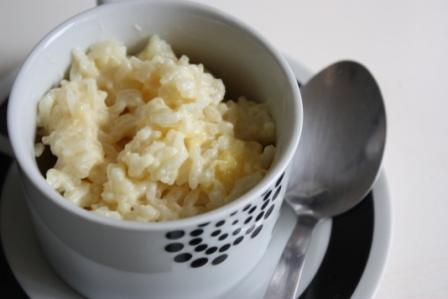
The other day my lunch was screaming for something sweet to seal the deal and I had about a ½ cup of leftover rice in the fridge. I decided to turn that, along with a Palmer mango, into a single serving of sweet rice for dessert.

Really easy, wonderfully tasty and it meets a 30 Food List goal. That’s all the motivation I need so here you go.

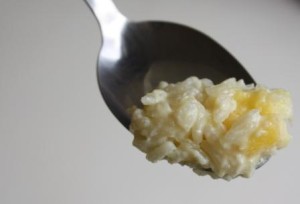
Single Serve Sweet Rice with Mango

½ cup cooked long grain rice
2 T sweetened condensed milk
2T coconut milk
3T whole milk
¼ cup chopped mango

In a small sauce pan combine the rice and all three milks. Cook on medium high heat until the mixture becomes bubbly and thick, about 10 to 15 minutes. Stir in the mango and heat through. Enjoy!

Here are a few other things I’ve already made on my 30 Foods List:


Wednesday, July 29, 2009

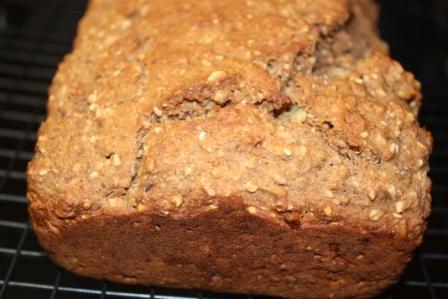
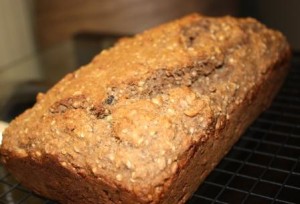
Nutty Grain Beer Bread

Oats, wheat berries, ground flaxseed, sesame seeds and walnuts. These are a few of the things I had sitting around the apartment that were begging to be used. When I stopped by the supermarket on Monday and walked past the beer aisle I caught a glimpse of what all these ingredients had the potential to become – whole grain beer bread!

Much of the dark beer here in Brazil is Malzbier. It’s very low alcohol and some compare it more to root beer than traditional beer. I used to enjoy it when we first arrived, but it is rather sweet. I can’t even think of anything that equates to it in the US. It can be enjoyable as a dessert, but lately I’ve found that it’s just too sweet for my preferences. However, I have learned it is a great addition to beer bread.

Hungry for a nutty, grainy bread to complement my breakfast, and as a base for my overconsumption of goiaba (guava) fruit jam I decided it was time to use of my stash of ingredients and see what would happen.

I did a quick search for a beer bread to guide me and found Peanut Butter Boy’s Whole Grain Beer Bread. This got me off to a good start.

I used mascavo sugar (unrefined cane sugar) and cut back on it a bit due to the sweetness of the beer. Then I soaked my steel cut oats and wheat berries for a ½ hour. Threw everything together and let ‘er bake.

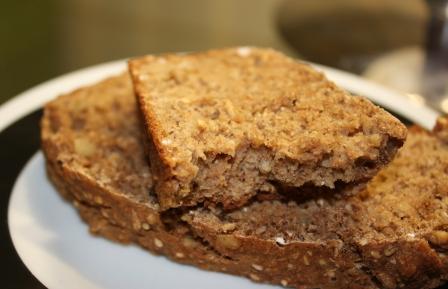
A definite winner. I’ll be making this one again and again. However, I would suggest soaking the grains a bit longer, perhaps 45 minutes, because there were still some rather hard bites to be found. I guess you could choose to sprout them as well, but I didn’t go that far. Also, any dark beer will do.

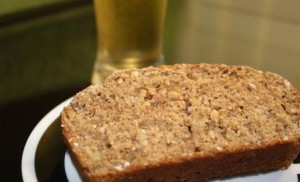
Fresh from the oven or toasted with jam the bread is full of crunchy texture with the mild sweetness of the dark beer. Hearty, healthy and filling – exactly what I was going for.

Nutty Grain Beer Bread

Adapted from Peanut Butter Boy’s Whole Grain Beer Bread

3 cups whole wheat flour
1 T mascavo sugar
1 T baking powder
1 t salt
2 T sesame seeds
¼ cup chopped walnuts
2 T ground flaxseed
1/3 cup steel cut oats (soaked and drained)
1/3 cup wheat berries (soaked and drained)
1 can (350 ml beer)

Preheat the oven to 375 degrees F and grease a 9 x 5 inch loaf pan. In a large bowl, gently mix together the flour, sugar, baking powder and salt. Stir in the sesame seeds and flaxseed. Next pour in the oats and wheat berries. It is fine if a bit of the soaking liquid goes in to add moisture. Mix well and then begin pouring in the beer a little at time as you stir until the can is empty. Then stir until the dough is well combined.

Pour into your baking pan, spread evenly and bake for 45 min to 1 hr. Once browned and baked through, remove from the oven and cool on a wire rack for about 10 minutes. De-pan and enjoy!


Monday, July 27, 2009

My Weekend Read – One Step Closer to Fake Food Free


At about 8:00 pm on Saturday night I finally began to read the book In Defense of Food by Michael Pollan. Less than 24 hours later I was finished. I guess that isn’t saying a whole lot since the book is only a couple hundred pages long, but I literally felt as though I couldn’t put it down. It was the ultimate thriller of all things food and health.

I read Omnivore’s Dilemma a few months ago and it was thoroughly enlightening. It confirmed many of the food related thoughts and views I had been struggling with as a person who spent her academic career studying nutrition, while also teaching me so much that I never even realized existed. It further fueled my desire to reduce processed foods and find ways to learn the origin of foods I do choose to eat.

I followed that up with Food Politics by Marion Nestle. A book that shook my nutritionist roots to their core and left me to question all that I had learned about nutrition thus far in my life and in my career. I mean all of this in the most positive way possible, but after that book I did need to take a break from nutrition reading to gather my thoughts.

I started In Defense of Food much in need of a motivational boost. Food, Inc. is out in the US along with other documentaries I’m seeing mentioned left and right on nourishing food blogs. I’m feeling a bit left out. While being abroad allows me to experience a new culture, I am also distanced from the changes going on in my own. I’ve felt unfocused lately with my own cooking and eating and what exact direction I’m headed.

Well I couldn’t have picked a better time to read the book. Consider my fire reignited and glowing brightly.

What Is It About This Info?

As I finished this book, I found myself wondering why it strikes such a cord with me. I’ve had that little voice that fake foods aren’t good for us for a long time, but nothing has really sparked my interest or driven me to change like Michael Pollan’s books. I’ve read plenty throughout the years about the dangers of refined foods, about how refined sugar has addictive properties and all that. However, all those books left me more knowledgeable, but not motivated to change.

What I’ve decided is that it has a lot to do with Pollan’s style. Through his writing he exudes a balance of logic and honesty. He isn’t a health fanatic selling the latest miracle cure or telling you that vegetarianism, meat-eating or non-dairy is the only way to live. He has science to back up his thinking, but he isn’t a scientist. He’s one of us, so-to-speak, trying to figure it all out too.

After reading his books with the information he pulls from himself and other knowledgeable people, not only do you feel as though you are more intelligent on the subject, but that you truly want to make long term change. Not only do you feel empowered, but also confident that your changes could actually make a difference.

A New Tradition

The book speaks a lot about traditional eating and how the past couple generations are more focused on industrial eating. This is why I think it is so hard for people of my generation to change. And by change, I don’t mean try, I mean change, as in throw out the processed foods – even the processed sugars and flours in moderation and on occasion.

A traditional way of eating comes from what we know, what we grew up with. Unfortunately if you are in my boat, you never knew a time when processed foods weren’t used. To change means we have to revert back to a time we’ve never known.

For me, this brings on visions of those meals and desserts that are my absolute favorites and which also use prepared, packaged ingredients. Things, at first thought, I would sorely miss and the elimination of which may even erase some fond memories. They’re okay in moderation, it doesn’t hurt to have it once a week/month/year, progress in food development isn’t all bad. Right? Well, these are the things I’m starting to question.

Don’t worry, I’m not becoming that foodie nutritionist, the one who doesn’t believe in an indulgence or splurge. I’m just sharing these thoughts and considering the fact that I may be redefining what an indulgence or splurge is for me.

Voting with Forks and Dollars

One of the most thought-provoking parts of this book is a short discussion about how we as consumers vote with our forks. I’ve never been one to jump on the bandwagon when it comes to boycotting things and/or companies. When someone says this company did this or that bad thing so we aren’t buying their products anymore, I’m not one to vocally join in.

Why? Well because it is the surest way I know to make myself out to be a hypocrite. Honestly, I don’t know enough about all of my spending patterns to confirm that I don’t support something that I’m not in complete agreement with somewhere along the line.

I know that I should, but companies own lots of other companies and it is difficult to be sure where exactly money goes. No, I haven’t researched every item I’ve ever purchased as a consumer. I’m getting better about it, but not there yet. So I may make my own quiet choices to not purchase from a specific company because of what I’ve heard from others, but I likely won’t be singing about it.

This part in the book really made me think though. I do need to consider my choices when it comes to food. As innocent as it seems, when I grab a bag of pre-made cookies because I didn’t have time to make something for that party, when I select a pancake syrup instead of maple syrup because the latter seems too expensive, or when I have that favorite nostalgic treat one last time, essentially I am supporting something I don’t wish to. Namely, the use of HFCS in foods or just fake foods in general. I’m beginning to feel more strongly that this is not okay. Not for me.

Voting with my fork and dollars is a power I have. It might be the only power I have in changing our society for the better. I feel like I need to be more responsible with this power.


There is another topic I want to discuss regarding the book, but I think it warrants a post on its own. I’ve already thrown a lot of thoughts out there with this one. Consider it Part 1.

I want to know what you think about the issues I’ve presented. Have you read the book?


This post has been submitted to Fight Back Fridays at Food Renegade

Saturday, July 25, 2009

Links to a Healthy Weekend


Happy Saturday! Around here it is cool and gloomy. I am loving it because it means we still have at least a few days of winter left before things heat up.

I had a day full of fitness planned and started it off by sleeping too late to make it to the gym for spinning! Oh well, the rain has come now and I wasn’t feeling up to a walk through it anyway. However, I do need to get back into spinning or some other cardio to balance out my running. I’m really craving some cross-training.

Today I also wanted to mention that, if you haven’t noticed, my posts are swaying much more towards the Brazilian side of things lately. I have a feeling this is going to be a theme for the next couple months. We move back to the US in October and I am feeling the need to try out many of the recipes I’ve had on my list here and keep putting off. The time is now or never, it seems.

So if you enjoy that cultural side of things, stay tuned! The blog is going to be evolving A LOT this last half of the year. As I move from Brazil, to our trip in SE Asia and back to settling into a makeshift US kitchen and then perhaps a permanent one a few months later if we found a house, things are sure to be interesting!

Here are a few of my favorite things from the week. I hope you enjoy your weekend!

Food o’ del Mundo posted a tasty Curried Rice Salad this week. I love the use of dried cranberries. I never have been able to get into raisins, but the cranberries I like.

A Life Less Sweet posted one great pie this week with Fantasma Pizza. Cathy participates in Meatless Mondays and this is a recreation of one her favorite pizzas from a local restaurant. I’ll be trying it soon!

Not Derby Pie put a refreshing spin on a tart and tangy dessert with her Cherry Pistachio Crisp. It looks wonderful and I never would have thought of adding pistachio nuts to a crisp dessert. Yum!

Tossing Out the Diet and Embracing the Fat was an article from the NY Times this week. I enjoyed the fact that they included Steven Blair’s research. I’ve heard him speak several times and I enjoy learning about his findings. He is a major researcher in the whole “fit and fat” philosophy.

My personal opinion is that health is about fitness, not weight. It should be about how you feel. If you truly feel great, then that may be the best weight for you. At the same time though, I don’t believe in using that as an excuse. If you say you feel great yet you are overweight, get no exercise and eat fast food five times a week, well, I don’t think you are being honest with yourself.

Eat right, exercise and strive to be at a weight where you feel vibrant and energized! If that is 15 pounds more than what tables and charts tell us it should, so be it.


Photo of a sunset on the island of St. Lucia, 2007

Friday, July 24, 2009

The Coffee Dilemma

Tuesday morning started out just like any other day. I went into the kitchen first thing, grabbed a coffee filter, added some of a my favorite Brazilian grounds, poured the water and pushed the red button. The button illuminated so I walked away to straighten up the kitchen then start up the computer.

A few minutes later I thought, “Hmmm, I don’t hear anything. More importantly I don’t smell anything.” I have a very inexpensive model of coffee maker I bought here and usually within seconds of pushing the “on” button the water starts to gurgle and a little steam is emitted from the top.

Still positive I went over and felt the machine. Cold. I checked inside and out for some sign of proper function, and started it again. Nothing. My calm, positive attitude slowly evolved into a bit of frantic thinking, and rattling and shaking the machine ensued.

Alas, the machine won. Less than two years old and it has bit the dust.

What to do, what to do. One option included buying a new maker for my last two months in Brazil. A possibility, but it seemed a bit wasteful. I could try to sell it upon moving or just leave it. The quality of small kitchen appliances here isn’t something you would want to ship home, trust me.

Sadly, investing the money in purchasing coffee every morning isn’t even an option here. There was no to-go coffee within the city until the McDonald’s started serving breakfast and selling it last October. I’ve had it a couple times and it is tasty and inexpensive, but it seriously takes a half hour to get the order here with your only bonus being it comes in a to-go. (That has been quite a big bonus, though, on some occasions.)

Then I started thinking. Well…I do have one more option which would eliminate the need for me to buy a machine or support the golden arches.

Meet my morning coffee maker.


Several months after living here I learned about the so-called “artisanal” way of making coffee. There are several cafes around our city that still make it this way for the public. I enjoy going there and watching the women behind the counter serve it to the men there for a quick cup in the morning while standing. Once my interest was peaked I bought the supplies and made it a few times for myself.

It wasn’t until we met with some new friends in Curitiba, that I learned that this style of making coffee is considered old school and artisanal. Apparently it is a lost art in many larger cities in southern Brazil. For comparison Curitiba is a city of almost 2M and Maringá has about 300K. Not so small in the US, but small by Brazilian standards when you compare it to cities such as Sao Paulo with 18 to 19M the last time I checked.

The process is simple. You toss the coffee, which is ground very finely here, into a pot with water. I use about 2 scoops of coffee for 2 ½ cups of water. You throw in the sugar at this point too. For me, that is a rounded teaspoon. Then you boil. Not a hard long boil, but enough to get it hot and dissolve the sugar and some grounds.


Next comes the filter that looks like a mini-fishnet. Made of cloth, the coffee drains through it like a filter so your grains don’t go to the cup. You pour the coffee through the filter and allow it to drip directly into the cup.


The process isn’t much unlike a mechanical coffee maker except for the fact that the coffee is cooked directly in the water. The water isn’t simply flowing through the coffee and into a pot. Although you do have to be present throughout the whole process.

It is also similar to what we call cowboy coffee or campfire coffee back home. Well, except for the fact that I’m using delicious Brazilian coffee beans. I would imagine it is tastier than most made at campsites. The brewing process results in a much stronger brew. I enjoy it, but I always have it cafĂ© com leite-style with milk.

The negatives are the clean up. I have to dump out all those grains, scrub the pot, clean the filter contraption well and allow it to dry after I make coffee each morning. I’m starting to get used to it though. I guess in this case I looked at going without the maker as a challenge. Why not enjoy the piece of culture I have for the time being? Even if it does mean an extra 10 minutes of cleanup in the morning.

Tuesday, July 21, 2009

A Match Made in Heaven – Avocados and Bananas


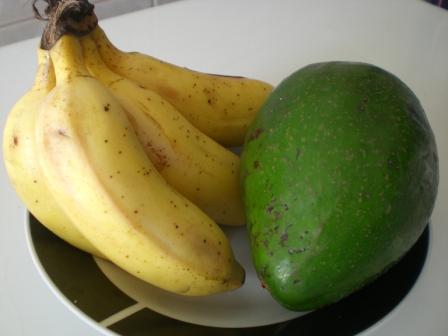
I think I’ve mentioned before that around here avocados are eaten as a fruit; sweet, not savory like in many other cultures. You won’t find it on sandwiches, in salads or as a salty condiment such as guacamole. Now I still love to enjoy my avocados the old fashioned way, as I refer to it. However, I’ve been really open to the idea of eating them sweet.

At my husband’s office a popular snack is to take fresh avocado slices, sprinkle sugar on them and eat them as I would apple or peach slices. Other Brazilians have told me they cut it open sprinkle sugar on it, drizzle it with lime juice, and eat it with a spoon. I’ve tried it with just the sugar and you know what? It isn’t half bad.

When I posted about this new-to-me food phenomenon on my ex-pat blog I got a lot of responses about avocados and bananas. Soon after that I went to my favorite little vegetarian buffet down the road and one dish on the salad bar was a bowl of cut up avocados and bananas together.


Nani, a Brazilian ex-pat living in Arizona, once commented on my blog that her dad was famous for his Vitamina de Banana e Abacate (banana and avocado vitamin). A smoothie of sorts made with avocado, banana, milk and sugar.

As interested as I was in this drink, it took me a long time to get around to trying it. In fact, I bought an avocado at the market last week and until last night it had been staring at me each time I opened the fridge door. Finally, last night after my run I gave it a try.

Oh my! I have no idea why I waited so long!

I have never had anything so creamy, sweet and slightly buttery. Words simply can’t do it justice. It is the ultimate of healthy, filling drinks. If you don’t like avocado, don’t worry. There is something that happens to the flavor once it is mixed with the banana. Honestly, I’m not sure I would identify it as avocado if I didn’t know it was in there. The best part is that it is full of potassium, monounsaturated fat, vitamin E, protein and calcium!

I froze my slices of banana first because I wanted the drink to be really cold and have a little texture. I also did not add any sugar. The banana was sweet enough. Finally, I used skim milk in my version.


Banana and Avocado Vitamin

Flesh of one ripe avocado
1 ripe banana, sliced (frozen if desired)
Milk

I used an immersion blender and a glass because that is all I have, but a blender would work well too. Blend the avocado and banana well. Slowly add a little milk at a time until you reach your desired consistency. I added about a cup. Pour it in a glass and your ready to enjoy!


************************
Or you could get involved in some of this Ice Cream Social action being hosted by Tangeled Noodle, Savor the Thyme and Scotty Snacks!

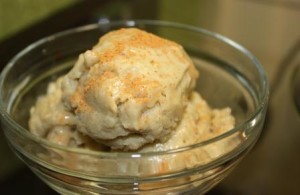
I turned the banana and avocado vitamin into Avocado Banana ice cream for my entry. I don't have an ice cream maker on hand right now so I made via freezin' and stirrin' in my freezer. The fat in the avocado keeps it nice and creamy and a sprinkle of cinnamon on the top adds even more flavor. This might just be the most nutrient-dense ice cream out there!


Monday, July 20, 2009

Finally Feijoada


One of the best things about traveling or taking part in an ex-pat experience is that you get to try the real thing when it comes to the foods of the place you are visiting. This can be as close by as Memphis barbecue or as far away as pasta in Italy. While foods are imitated everywhere and a select few are exactly like the real thing, many aren’t.

I have yet to have a German sausage that was anything like those that I’ve had in Germany and Austria. There is nothing to compare to the freshness of a pint of Guinness in Ireland. No jerk chicken tastes quite like that which can you get made the traditional way in Jamaica.

I’ve mentioned before that since being in Brazil everyone always asks about feijoada, the national dish made of black beans and pork and accompanied by rice. I think this dish serves as a great example of one of those foods made elsewhere, but is never quite captured completely. This is mostly because with foods such as this we tend to take out those parts that don’t fit well with our culture.

I’ve been in Brazil two years and until Saturday I had never had feijoada. There are two reasons for this. One is because I really didn’t have any doubts that I would like it; I mean its rice and beans with meat. It really isn't incredibly different. The second is because this is how a conversation typically goes regarding feijoada with almost every person we’ve discussed it with in Brazil.

Them: “Have you had feijoada?”
Me: “Not yet.”
Them: “Oh you have to try it. It is soooooo good.”
Me: “I’m sure it is. I’m just not too interested in the random pig parts that show up in there.”
Them: “Oh, I wouldn’t have feijoada out. I only eat the feijoada my (grandmother, mother, etc.) makes.”

Basically people tell us to go eat it, but that they wouldn’t. That really didn’t provide much motivation for me. However, my husband did want to try the real thing and I felt compelled to try it since we are living here and I wanted to be able to say that, yes, I had eaten feijoada.

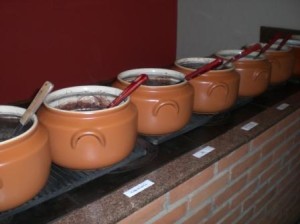
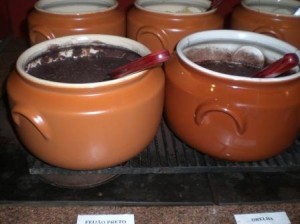
So we headed out Saturday to a local feijoada buffet. The good thing about these buffets is that they separate out all the parts. Each of these crocks is filled with a different version of feijoada with different meats, including one that was simply black beans.


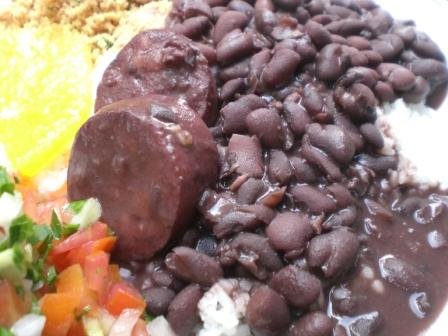
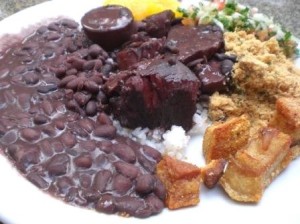
I ate only the variety that had calabresa (a sausage) and a little bit of carne seca (dried meat). However, if one were so inclined you could have pĂ© (pig’s foot), orelha (pig’s ear), or rabo (tail).


The truth is I may be willing to try a bite of these mystery meats, and I did some digging around with the spoon to see what they looked like. However, as I pulled up the spoon to see a big piece of flabby pig ear, I knew I couldn’t do it. A bite is one thing, but having a huge piece of it staring back at me from my plate is something I just can’t stomach.

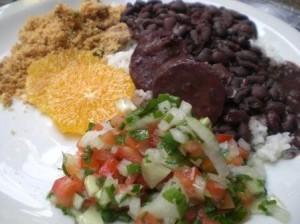
Below is a picture of my plate with calabresa and my husband’s with calabresa and carne seca. The best part of the meal for me is usually the addition of farofa (that toasted manioc flour) and the vegetable vinaigrette.

This meal is also served with orange slices to “help with digestion”. I’m not sure how technical this recommendation goes beyond that statement. However, I suspect it has something to do with the fact that vitamin C helps the absorption of non-heme iron like that found in dried beans.
I must cover the desserts as well. You know me.


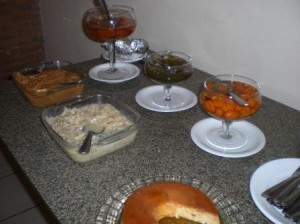
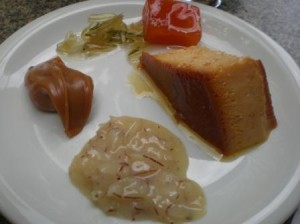
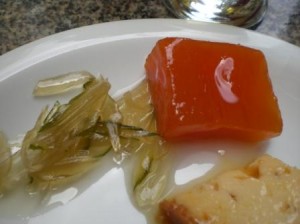
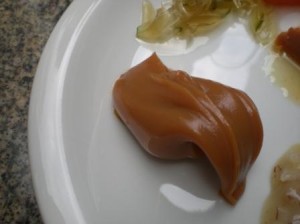
There was a small buffet of cocada (coconut in sweetened condensed milk) and pudim which is a flan. There were some candied fruits such as abobora (pumpkin) which is one of my favorites. It is candied in a ton of sugar along with some spices, namely clove. Finally at the end of the table was a huge bowl of doce de leite.

As we were eating our dessert, a thought occurred to me. Back home we tend to put those decadent things like caramel or doce de leite in the center of the cake or in the frosting all the while wishing we could dig into a big bowl of just that. Well, here they go straight to the punch and do just that! Doce de leite is eaten as a dessert all on its own.

So finally, I’ve had feijoada, and yes, it was good. However, I still feel that there are so many dishes here in Brazil that are better than feijoada. So if you visit, try it, but don’t stop there. Venture out and try Moqueca and CamarĂŁo na Moranga (shrimp and cheese baked in a pumpkin), too.

Sunday, July 19, 2009

Links to a Healthy Weekend


It is a beautiful Sunday afternoon here; bright blue skies and plenty of sunshine. I’ve had another culturally filled weekend, but it came after an already awesome week. I finally ran a 10K! On Wednesday I’m not sure what got into me, but I just felt like I could go and I pushed through.

I didn’t think I’d ever get here and quite honestly I’m not sure when I’ll be able to do it again, but after training since the beginning of January. I finally made it! I’ve taken on running basically because it is something I’ve never been able to do successfully. I had run a 5K or two, but nothing spectacular. I’d run a few months and give up because it was so hard for me. By hard I mean, when I start training I can typically go about one minute before stopping. Seriously, I have never been a runner.

So I’m definitely celebrating this accomplishment. In addition to all that, there were all kinds of good reads this week. I hope you enjoy them as much as I did.

California calorie law alters chains' fare was an article from The Sacramento Bee which reported on how restaurants are revamping their recipes since they will soon have to put calories on their menus. Honestly I think this is one of the biggest positives that could come from these kinds of laws. There are always going to be people who don’t care about what they order, but if it motivates restaurants to switch up a few things to make dishes a little lighter and portions smaller, that is a great thing.

Popcorn & Pretzels. I loved this little piece of healthy information from Cooking Light. Popcorn has become my favorite snack and I have it almost every day. Lower calories, fiber, a whole grain – all reasons why I love it. I’ve never really been a pretzel person. Well, unless it is a soft one.

So You Think You’re a Foodie was a post this week on Gourmet Girl Magazine’s blog, Kitchen Rap. I’ve often thought about the ideas presented here. There are so many different types of foodies and food blogs. It also includes one of those interesting food lists. I love seeing how many I’ve tried before. I scored about a 54 on this one.

Eating healthy can cost more, but doesn't have to, experts say was a great article from USA Today this week. There is a lot of truth here. Basically you have to be a little less exotic, but you don’t have to eliminate healthy foods when you are low on funds.

And finally, just to tease your taste buds, Mindy’s Mouthful did a roundup of a recent fest she attended in Germany. All that sausage and beer! German cuisine is truly one of my favorites.


Photo of two dogs that like to hang out near the cathedral. Saturday afternoon they had taken over the front steps to enjoy the overcast day.

Thursday, July 16, 2009

Big Papaya, Small Papaya – Same Fruit, Different Name


Most of us are pretty familiar with the papaya even if we don’t live in a place where they are regularly available. The papayas I had always been familiar with were about the size of a large white potato.

When I came to Brazil and started exploring all the fruits available I soon found papaya was widely available and very popular. It is the main component of salada de frutas (fruit salad) when you order it at a restaurant and I have yet to see a juice menu without it listed.

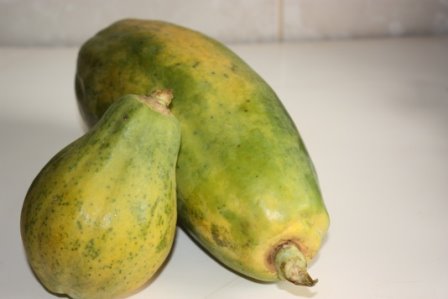
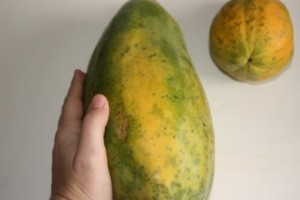
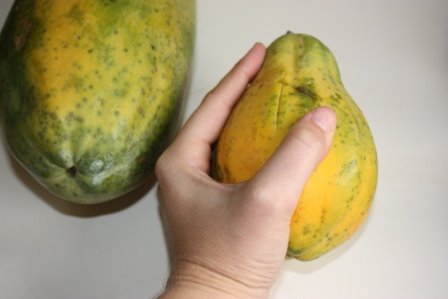
I found those small papayas I was familiar with right away in the supermarket. They are called papaya in Portuguese too, but sometimes you will find it spelled papaia. Then I kept coming across this fruit that looked like an overgrown papaya and the signs always indicated it was mamĂŁo.

Here are pictures so you can see the size difference. The mamĂŁo really is a huge fruit.


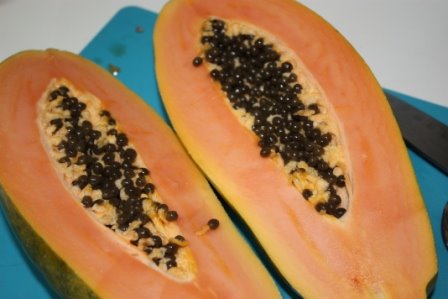
Upon purchasing one and trying it at home, I quickly realized it is really just a big papaya. I’ve asked around about the two fruits and that is pretty much what everyone here tells me as well. Although, the smaller papaya is supposed to be a bit sweeter. I can’t tell a flavor difference though. They look and taste exactly the same to me.


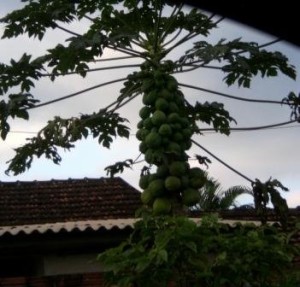
To tell you the truth, I’m not a huge fan of papaya. I enjoy it mixed in with other fruit in fruit salads and juices, but I don’t like the flavor enough to sit down to a big piece of it. Actually the most interesting thing about the fruit, the mamĂŁo specifically, is how it grows. I have been trying like crazy to get a photo because typically I only see them when we are driving. This is the best I have been able to do.


They grow on a tall, incredibly skinny tree that branches out with leaves at the top. The fruit grows in numerous bunches right at the top of the trunk.

Despite the fact that it isn’t my favorite, I do buy papaya or mamĂŁo every now and then. I consider it my duty to appreciate my access to all these good things and it usually goes into juice. However, the other day I was feeling a little creative.

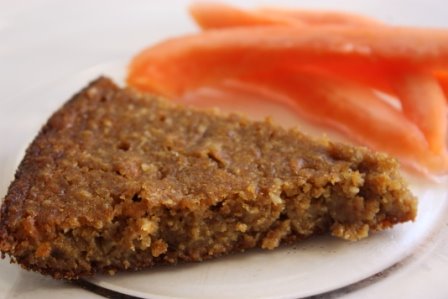
I wanted to use the mamĂŁo, but wasn’t hungry for dessert. The thought of a bread entered my mind, and then, why not a breakfast cake. Who doesn’t want cake for breakfast?

This cake is full of whole grains and is hearty and filling. The papaya simply adds moisture as the flavor of the fruit itself isn’t very strong. I will say that it is very, very buttery. In fact, I think I’ll probably reduce the butter to a 1/3 cup the next time I make it. Because it is so moist, you’ll want to store any leftovers in the fridge.

Papaya Breakfast Cake

½ cup butter, very soft
½ cup mascavo sugar (unrefined cane sugar)
2 eggs
1 cup papaya or mamĂŁo, pureed
¼ cup steel cut oats, soaked for at least a half hour and drained
½ cup whole wheat flour
1 tsp baking soda
½ tsp salt


Cream butter and sugar, then mix in eggs. Stir in papaya, mix well. Next stir in soaked oats and stir until combined. Finally add in flour, baking soda and salt and combine all ingredients. I used a lightly greased 10 inch round, glass baking dish. However, given the amount of butter I think I could have gone without greasing it. Any square pan would work fine too. Bake at 375 degrees F for about 25 minutes, until edges are browned and center is baked through. Allow to cool about 5 minutes, serve warm or at room temperature.

Wednesday, July 15, 2009

Walnut Pesto: A Recipe for Healthy Bones

I had never used fresh herbs in cooking until I was in college. Doesn’t that seem crazy? We had plenty of fresh fruits and veggies growing up, but herbs just weren’t a focus around our house. When I was in college I had to take a food service class one summer which involved cooking for a small restaurant in our department. The chef had an herb garden behind the building where we collected some fresh herbs before each class.

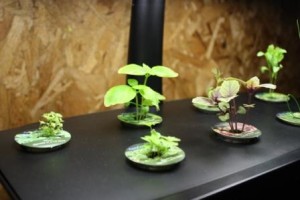
It was a big discovery for me and since then I’ve grown my own herbs when possible or buy them fresh when I can find them. I even love herbs so much that on my last family visit to the US my brother set up his AeroGarden to grow some herbs for use in my cooking. When I got there it looked like this.


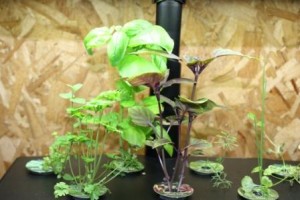
When I left it looked like this. These little things are pretty amazing.


It took me forever to find fresh basil in Brazil, mostly because I had no idea what the name was. It is called manjericĂŁo in Portuguese, by the way. Its availability isn’t consistent, but when I find it I always grab some. I love the smell. Basil is tied with rosemary for me regarding my favorite herb scent.

Of course, I am also interested in the nutritional value of basil and herbs in general. It turns out that oils in basil have anti-bacterial properties and it is packed with vitamin K (3). In addition to its role in blood clotting, more recent research has linked vitamin K to bone health indicating that it plays a role in the development of bone mineral density and in decreased risk for bone fracture(1).

In addition, more research has confirmed that if you want these bone health benefits, skip the supplements (2). The benefit is seen when consuming more vegetables and legumes, not vitamin K1 supplements. Of course this makes me very happy. I think we all know I am in favor of food not pills.

There are two main things I use my basil for – one is margarita pizza and the other is pesto. My first experience with pesto involved dried basil and garlic, which is good, but not at all the same as using the fresh herbs.

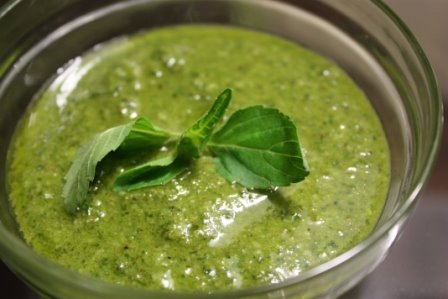
This is one of my favorite types of pesto using basil and walnuts. It is a modified version of the type we used to make in the bread store I once worked in. The ingredient amounts are very general, just tossing in this or that until you get the preferred consistency. I use it for pasta, pizza sauce, in scrambled eggs and of course spread across a warm slice of bread.


Walnut Pesto

1 bunch fresh basil, about 1 cup loosely packed leaves
2 cloves fresh garlic
2 handfuls chopped walnuts, about 1/3 cup
2 tablespoons parmesan cheese, freshly grated
Salt and pepper to taste
Olive oil


In a food processor (or in a tall mixing glass if you plan to use an immersion blender like I did) combine the basil and garlic and process about 15-30 seconds until things are roughly chopped. Add the walnuts, cheese and about a tablespoon of olive oil.

Process as you add in a little olive oil at a time. Continue until all ingredients are combined and nuts are ground. Continue to add olive oil until you reach your desired consistency. I like mine a little thick so it is spreadable, but if you want to use it as a dressing, add more. Taste and sprinkle with salt and pepper as desired. Makes about 1 to 1 ½ cups of pesto.

References and more on the health benefits of basil:

1. Pearson, Debra A., Bone Health and Osteoporosis: The Role of Vitamin K and Potential Antagonism by Anticoagulants. Nutrition in Clinical Practice. 2007; 22(5): 517-544.
2. Shea, M., Booth, S.L. An Update On The Role Of Vitamin K In Skeletal Health. Nutrition Reviews. 2008; 66:549-557.
3. World’s Healthiest Foods: Basil

Monday, July 13, 2009

Cowboys and Cow Ribs

Imagine if you were attending a local festival celebrating your culture. Perhaps it is a bit of a mini-family reunion where your extended family has traveled to join in the festivities. As you are seated around your table waiting for food, someone approaches the table to tell you that there are foreigners present and they need a place to sit.

Would you welcome them to your table?

Let me tell you about my Sunday.


Early in the week we had been told by some friends about a festival taking place just outside the city. Costela ao Fogo de ChĂŁo festival, or more a way of cooking and eating, that celebrates the Brazilian Gaucho, cowboys typical to South America and from what I’ve learned most prominent in the south of country. You will likely hear of them in Argentina too which creates a bit of a rivalry from what I hear.

We made the decision to attend the festival after Sunday turned out to be a beautiful day and arrived to look around, not exactly sure what we were in for. We knew the costela (ribs) were a big draw, but we didn’t know what else was involved. The day turned out to be quite the cultural and culinary adventure, one we weren’t at all expecting.

We soon found a gymnasium-type facility decked out in colorful decorations, overflowing with people and filled with dinner tables. In the middle of each table was a round base, and in this base was a massive piece of cow rib.


Throughout the dining rooms there were tables set up with vinaigrette (tomatoes with onion, lime juice and parsley), lettuce, mandioca (yucca, manioc), rice, farofa (toasted mandioca flour with bacon, onion and corn) and rolls. The idea was to surround your table with family and friends, fill your plate from the salad bar and then feast off the slab of ribs elevated in the center of the table.


We weren’t exactly sure how things worked. Many of the tables were reserved and we had started to think that it was a private event or maybe that we needed to have made reservations. Finally we saw a gentleman dressed in gaucho attire and we decided to ask him what we were supposed to do and if we could eat.

Immediately he asked us if we were German (as usual). My husband told him we were from the US and from that point things just happened so fast. Before we knew it he had grabbed a lady who happened to be an English teacher. She was asking us if we had someplace to sit and told us to hold on while she found the boss.

It turns out that the boss was the head of the CTG (Centros de Tradições Gaúchas) organization. He appeared very happy to see us and in a few minutes we were directed to the table of his family. As it turned out two members spoke English and even though my husband told them he spoke Portuguese and I spoke a little they continued to communicate with us in English. Incredibly hospitable, in my opinion. They were having a bit of a family reunion and let us know that their family was from Rio Grande de Sul (known for gaucho traditions) and had moved to both Curitiba and Maringá.

I have to say it was the most welcoming, gracious experience I have had in our two years here. Looking back, the whole event and how we were treated was unbelievable. Here we were complete strangers, foreigners at that, and we were simply wondering if we could get a table to eat. They welcomed us to the experience, and were clearly excited for us to witness a piece of their culture. We were even addressed during the announcements!

So let’s talk about this costela (the rib meat of the cow) as it was certainly the main attraction at this event. Our new friends told us that the ribs are salted the night before and then the cooking begins about 5:00 a.m. over the open flame. That means they cooked for about seven hours before making it to the table. Fogo de ChĂŁo, which you may be familiar with because it is the name of a popular chain of Brazilian restaurants in the US, is roughly translated fire of the floor, or fire of the earth.


The meat was coming out all over the place, and if you weren’t carefully, chances are you would get bumped in the backside with a big slab coming out on a long metal pole with a sharp hook which the meat was attached too. From there, on the table it goes and the designated carver slices off pieces for everyone around the table.

The meat itself was just okay. This was much more about the experience itself. It was very, very fatty and resembled a roast beef like my mom makes at home with the carrots and potatoes. I can appreciate the fact that it is loved around here though. I just can’t eat it like most Brazilians do, fat and all. I carefully picked around the fat to get to the better meat. As is the case at most parties here, a second portion was practically forced upon us, but after that I was done for sure. The rice, vinaigrette and farofa were much more to my liking.

At dinner the family was telling us about their horse. He was described as a champion and after we ate we went out with a large group of people to walk through the stalls and take some pictures of him. We were met by a barn full of horses, some wanting a bit of attention, others content to eat their hay and still others a bit moody.

The champion’s name turned out to be Zeus. Zeus fully met the criteria of being a self-confident champion. He was bit irritated at being bothered during his hay munching. As one of the men teased him a little, I have never in my life seen a horse practically bust through a stall gate to try to bite someone. Zeus may have been beautiful, but he was not all that friendly. In fact, they closed up the stall and I didn’t even get a picture. He looked like his day was going bad enough already and I didn’t think a photo would sit too well given his current mood.

We did meet some other friendly horses. The names were the best part because many of them were in English. My husband really liked Cowboy.


Hanna was my favorite; a sweet girl with her head out of the stall welcoming anyone who passed by to give her a scratch. I couldn’t help but laugh when two young boys walked up to give her hay and started calling her Hannah Montana. Apparently she is popular here too.


What a completely unexpected day. In fact, until about 10 minutes before, we weren’t even sure we would go. I’m so glad we did and it makes me wonder if I’ll ever have the opportunity to return this type of hospitality and cultural experience to a complete stranger someday.


This culture and culinary experience was a good fit for both my blogs so you'll find this cross-posted at Blondie in Brazil.

Sunday, July 12, 2009

Links to a Healthy Weekend


Has this weekend already come to an end? It is Sunday evening around here and pretty hard to believe. I had a weekend full of culture which I plan to share with you more throughout the next week.

As I kept up with my reading throughout the week I came across a few fun things that I couldn’t pass up sharing, even if this weekend is almost over.

Night Owls May Benefit from Evening Strength was an article on CNN this week reporting on a study about night owls and early birds. I am happy to have found some scientific support for my inability to be an early riser and exerciser. I have much more energy in the afternoon and evening.

On a similar note, Living Healthy in the Real World had a post about Sleep vs. Exercise. Which would you choose?

Tokyo Terrace, a great food-inspired blog written by a US ex-pat living in Japan, shared a beautiful spread for an easy, elegant brunch. As an ex-pat myself, brunch is one thing I miss dearly. I didn’t have it often, but there is something about the combination of breakfast and lunch in a relaxing atmosphere with friends that I really enjoy.

My Food and Life Encounters posted a recipe for Feijoada. I believe I’ve posted a recipe from her lately, but I couldn’t pass up sharing this one as well. Everyone asks me in one way or another about feijoada when they find out I live in Brazil. The two seem to be inseparable.

Photo of Gidget born in June with mom Marylin. The horses of my dear friend, Jackie.

Thursday, July 9, 2009

Zucchini Quiche with Whole Wheat Crust


There was a time when the egg yolk rarely made it into my diet. I hastily followed the crowd when this food made the spotlight for being high in cholesterol. The truth is I enjoy egg whites just as much as the whole egg. I also tend to enjoy just eating the white and not the yolk when eggs are hard boiled.

However, I disliked that nagging voice in my head telling me that I shouldn’t be enjoying the whole egg on rare occasions. Fortunately, as seems to be happening with a lot of foods previously labeled unhealthy, the nutrition news changed and eggs came back as being a food now known for its healthy attributes which outweigh any nutritional shortcomings.

I gradually started eating the whole egg again and said good bye to that nagging voice. I knew my great grandfather couldn’t have been all wrong considering he lived into his 90s and ate almost a dozen fresh from the farm eggs a day.

The main thing that got my attention concerning health and the egg was choline. Egg yolks are one of the richest sources of choline, which is part of the B vitamin family. The most important benefit for me being that it is necessary for brain health.

I have eggs often and many times I will include one yolk and multiple egg whites when I just want the protein, but don’t want a lot of calories. The whole egg has about 70 while the white has about 17. That way I can still benefit from the choline and have a filling meal with a lot of protein.

One of the best ways to use whole eggs is in a quiche. I have always enjoyed quiche with its buttery crust and airy texture. You can also fill it with all kinds of vegetables and flavorful cheeses which is a huge bonus.

Earlier this week I had a zucchini that needed to be used up so I decided shredding it for a quiche would be a great way to enjoy it. I also had some smoked provolone cheese which is one of the better cheeses I find here and offers so much flavor to many of the things I make from pizza to a green salad.

But what about the crust? I wanted something partially healthy, but still rich and buttery. I haven’t had access to a rolling pin for two years. It is tucked away in a storage unit in the US, so I’ve become a big fan of pat-in- the-pan crusts. I decided to take the one I regularly use from the Joy of Cooking and make it whole wheat.

It turned out great! Still buttery, but with a crumbly texture and a flavor that really paired nicely with the eggs, veggies and cheese. In fact, I think I am going to attempt at making a sweet version of it soon for a pie adding some spices such as cinnamon and nutmeg.

Zucchini Quiche with Whole Wheat Crust

1 ½ cups whole wheat flour
½ tsp salt
½ cup butter, softened
Milk

¼ cup onion, finely chopped
¾ cup zucchini, shredded
1/3 cup smoked provolone, shredded
4 eggs
1 tbsp flour
1 cup of milk
½ tsp salt
¼ tsp black pepper
½ tsp cumin
½ tsp hot paprika

Preheat the oven to 350 degrees F. In a bowl mix together whole wheat flour and salt, cut in the butter and mix with a fork or pastry blender until butter is incorporated and dough is crumbly. Slowly add milk, one tablespoon at a time until the mixture forms a dry, yet cohesive dough. Press the dough evenly into bottom and sides of a deep, 9 inch pie pan.

Sprinkle the onion, zucchini and cheese evenly over the crust and set aside.

In a bowl or in a blender combine the eggs, flour and milk. Mix well with a whisk or in the blender. Add the remaining seasonings and whisk or blend again until the mixture is somewhat frothy. Pour the mixture over the vegetables and cheese in the pie crust. If your pan is not deep enough you may want to cut back on the milk to make less egg mixture. Leave at least a ¼ inch of crust visible around the edge.

Bake for about 45 minutes to an hour. The egg will rise a bit and the top should be slightly browned and the center set. Allow to cool for five minutes, slice and serve. Makes six to eight servings.


Tuesday, July 7, 2009

Becoming an In-Season Eater


I know you’ve read the advice as much as I have; in a book, a magazine article. I’ve even shared the advice a time or two. Eat in-season.

On the surface it is easy to determine what this term means. Eat foods when they are at their freshest, when they are harvested in your particular part of the country or world. Why? Well, because this is when they are at their flavor and nutritional peak. So we strive to eat asparagus and berries in the spring, squash and green beans as the summer rolls on and sweet potatoes in the autumn.

If you live in an area with access to CSAs and farmer’s markets it is easy to shoot for this goal of eating in-season, but it is likely that we eat in season in combination with eating out of season. There is likely something we pick up from the supermarket during an off season just to create a particular recipe.

However, what if one chose to eat only in-season? What exactly would this mean, and more importantly how would it affect one from a nutritional and health standpoint?

This is something that has been on my mind a lot lately. I really admire those people I follow who get a CSA box all summer and eat only from that box creating wonderful recipes. That is truly part of the eating in-season equation. And let me say this first off, the idea of eating in-season where I live now is a bit of a joke. While specific fruits like mangos and guava, and veggies such as corn do have a distinct season here, most everything else grows year around. Eating in-season in southern Brazil involves no sacrifice.

I’m looking at choosing this eating style when I return to the US though. I will be back in a place that has 4 seasons and the availability of fresh foods varies widely to the point of becoming non-existent in the winter. However, my belief in the importance of eating in-season is growing by the day. It is often better for the environment and honestly a bit of a challenge when it comes to cooking; one which I am up for.

As someone who cares a whole lot about nutrition though, this is where my concern lies whether it is well grounded concern or not. That is what I’m trying to figure out. In the summer, an in-season diet is obviously full of produce. Those recommendations to eat a variety of fruits and veggies in a variety of colors is easy fulfilled, but as months linger on what will happen?

Eating in season for me, in my area, will likely mean berries as a major fruit source in the spring and summer followed by lots of apples in the autumn. In addition, through autumn and winter long lasting potatoes, sweet potatoes, pomegranates, cranberries and squash will be the main produce sources, in addition to anything frozen from fresh throughout the summer. Yes, I do feel that self- frozen from fresh is an option with in-season eating, but even then you don’t have access to all of summer’s produce selection.

Can the body sustain itself nutritionally on only what is offered in-season? Well, I’m not sure what science would say with all its recommendations, but my gut tells me yes. I’m beginning to believe that this is what we were meant to do, and while I don’t believe that all advancements when it comes to food (regarding its growth and distribution) has been bad, maybe I’d be better off sticking to an in-season schedule.

I’m not saying I won’t ever buy a bland tasting strawberry in autumn again for a recipe, but it will not happen very often. This idea of true in-season eating and only in-seasoning is becoming more appealing to me. I’m not sure if it is an issue of the environment, health or just a challenge, but it is something I’m planning to focus on in a few months when we leave Brazil and return to the US.

How do you feel about only in-season eating?

Monday, July 6, 2009

Guest Post at 5 Star Foodie


Happy Monday!

I'm honored to have a guest post up at 5 Star Foodie today! Head on over to learn more about about Brazilian desserts and candy!

Saturday, July 4, 2009

July 4th Links to a Healthy Weekend

Well, I still didn’t get many posts up this week, but I couldn’t bear to leave you without any links for two weekends in a row. Although, I expect many of you are out enjoying summer fun on this 4th of July.

Last night we went to an English school in the small town where my husband works and helped host a bingo party. Last year we did a 4th of July party so it was fun to do something a little different.

We had hotdogs (cachorro quente) which around here means tomatoes and onions cooked down into a thick stew and sliced hotdogs mixed in. Another option you can find is the whole hotdog with this stew on top. It is then served on a bun (much bigger and sweeter than buns in the US) and topped with batata palha, or matchstick potatoes, as we used to call them. Not exactly health on a bun, but there were some veggies in there somewhere.


Here are a few great recipes, ideas and reads from the week.

Kahakai Kitchen featured a recipe for Thai-Flavored Ratatouille. Tasty veggies in a sauce made with almond butter! You know I love peanut sauces and I’m excited to branch out to almond butter sauces as well.

Meringue Bake Shop celebrates the 4th with the cutest cupcake creation ever – Cupcake Kabobs! What a creative idea!

A new position stand on the health benefits of a vegetarian diet was released by the American Dietetic Association this week. I found the recap interesting because it seems they’ve taken a closer look at the details of this type of diet. I'm looking forward to reading the entire position stand.

I think most of us would agree that we already knew vegetarian diets can be healthy, but I appreciated the fact that they emphasized the term well-planned. I met way too many girls in high school and college who would eat boxed macaroni and cheese while the rest of us ate meat and made it a point to announce themselves as a vegetarian.

In my opinion, just because it is vegetarian doesn’t mean it is healthy. Similarly just because it has meat doesn’t mean it is unhealthy. Both eating lifestyles can promote health and wellness if food source, nutrients and portions are taken into consideration.