Browsing Category

Nutrition and Nutrients

Easier Exercise This Weekend

August 1, 2008

I’m going to steer away from food for a minute today and talk about exercise. My brother just sent me the following article from Yahoo Health.

It is just more fuel for my anti pill-popping fire.

Drug gives couch potato mice benefits of a workout

You knew it had to be coming. If there are pills for eating soon there had to be pills for exercise.

Actually, I am a little surprised that the exercise pills didn’t come first. I mean, most people actually like to eat, however, many people loath exercise.

Of course the pill hasn’t been tested in humans. If you are a mouse and dislike moving your bum, then you might be in luck. The pill not only caused increased calorie burn, but also some signs of increased endurance capacity.

Unfortunately no pill will ever match real exercise, just as no pill can match real food.

You can show me calorie burn and endurance, but what happens to decreased anxiety and depression, healthy bones, muscle development, and socialization.

All are benefits of regular real exercise.

Now I will be honest. I’m at one of those motivational lows at the current moment where I’m having a really difficult time getting my butt to the gym. Even at times like these, I still wouldn’t consider a pill.

In addition to the fact that I’d miss a ton of benefits, laziness bothers me. Pill = laziness for me in this case.

Even if you have trouble moving due to certain conditions like the article mentions, walking 5 minutes is more beneficial than nothing at all. It is more about behavior change than physical changes a lot of the time.

The best line is the last one in the article. “For the majority of people,” she said, “it would be better to do exercise than to take a pill.”

At least they made a point to say it. Maybe there is still hope.

Photo courtesy of Free Range Stock

Well Said

July 18, 2008

If you feel the same way I do about real food and physical activity (and even if you don’t) you should check out this video.

It touches on the fact that the answer to our health problems are simple and on the fact that media and drug companies have manipulated us into thinking that we have everything under the sun and need a pill for it. The best part is the comment that diet and exercise do not fail.

Same Old Suggestions

July 16, 2008

I know you’ve seen them before – those articles that pop up in all health magazines offering little tips for cutting a few calories each day. These types of articles and their tips usually elicit three different responses from me.

“Um, I am a basically healthy person and already do this.”

“What in the world?”

Then there are a few that make me say, “That is actually a great idea.”

I really support the theory behind these kinds of articles because the idea of cutting a few calories each day is perfect for weight loss and maintenance. I came across one last night that had me concerned, though. As much as health is evolving and people are increasing their awareness about real food, nutrition researchers and practitioners still can’t break some of their old fashioned suggestions.

Let me give you a few examples of the suggestions I saw.

Have diet soda instead of regular soda.
Order fat-free cream cheese.
Have fat-free fudge pops instead of chocolate.
Leave food on your plate after each meal.
Skip egg yolks.

I don’t think I need to explain the first one given my past posts. You know I’m on a mission to greatly reduce and someday eliminate diet sodas. I also don’t think synthetic fat replacers are the way to go, especially when it comes to replacing chocolate. Personally I would never substitute anything for chocolate. Even a little bit of milk variety is good for the soul, make it dark and it is good for your heart too.

When it comes to leaving food on your plate, this is something I’ve struggled with from a wastefulness stand point. While I don’t think we should consume huge portions, I think it is irresponsible to waste the food we are given. A better suggestion for me is to split the meal in half and take some home or order a smaller portion.

While I love egg whites and their health benefits as much as the next nutritionally conscious person, I see a place for egg yolks in the diet. Egg yolks are brain food. While you save calories (about 70 in the yolk, versus 17 in the white) and fat by choosing whites you are also loosing some pretty beneficial nutrients for the mind. For example, egg yolks contain necessary choline, a nutrient that also plays a role with the metabolizing and accessibility of folic acid.

Yes, there is the cholesterol concern, but a person can eat a few egg yolks a week and maintain health. Just keep your cholesterol intake throughout the rest of your day in check.

In fairness, the article did have some decent, applicable tips. Things like diluting juice with water and leave the butter off popcorn. You can check it out here to see for yourself.

Seeing the suggestions as mentioned above just reminds me that we have a long way to go before real food is supported as healthy over fat-free, sugar-free versions. I think there has been a lot of progress over the years. I’m just wondering when we’ll get to the point of stopping suggestions for diet soda for health reasons. Why not sparkling water? Or why not encourage full, rich foods in moderation for health? Hmm…maybe I should write my own article.

Photo courtesy of Free Range Stock

Pill Popping

July 7, 2008

I mentioned before when talking about multivitamins

that I am not a big fan our nutrient pill popping habits in the US. With the advances of modern nutrition research we are learning more about what food components are good for us and how exactly they benefit our health.

We know that green tea is full of antioxidants. Wine, due to the skin of grapes, contains this amazing little component called resveratrol that has anti-aging properties. Fish oils can improve cardiovascular health and reduce inflammation.

All of this we have learned from nutrition research. After finding this, do you know what we have done with this information? Yes, we’ve encouraged people to consume the foods and drinks. Well, except for alcohol. Our government can’t be irresponsible and promote alcohol consumption despite the fact that cultures all over the world enjoy the health benefits. Sorry, that is another topic all together.

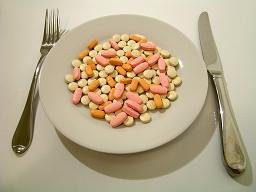
Anyway, along with a little promotion about including it in your diet came the huge spike in the creation of supplements. If we can identify the one tiny substance in a wonderful food, we should just put it in a pill and consume it that way. How innovative. How convenient.

My question is – why? Why would we rather swallow a pill than eat a delicious salmon entrée? Why would we rather turn to a pill bottle than to an evening with a glass of wine, socializing with friends? Is it that people want to feel better about consuming fast food daily or skipping meals by popping a fish oil pill every now and then?

I’ve tried to figure it out, but it just makes no sense to me. I understand the theory behind some of it. I did a project about green tea in school and I know to reap the benefits of some of these compounds you need to take in large amounts. Usually more than most people would consider having in a day. However, with regular consumption over time I truly believe you’ll get these same benefits. Healthy cultures like the Japanese and Chinese speak for themselves.

There are two main reasons why I disagree with this society that has been created. The first is that it takes away from the enjoyment of food. This is something the US as a whole has long forgotten and many other cultures still remember. We should not be scared to enjoy real food, even those foods that have a little too much fat and calories should be enjoyed in moderation.

Eating should be satisfying. Personally, I want to eat all those foods, taste them and savor them, not just swallow them. Getting up on a cool morning and enjoying a cup of tea has benefits for both physical and mental health, as does the consumption of many other real foods.

I feel that a lot of our problems both with obesity and obsession with healthy foods – yes they are both problems, comes from the fact that we simply do not have a healthy relationship with food. We worry and think about it so much on both ends of the spectrum that we forget to enjoy it.

Second, we take away additional benefits of the foods that contain these substances when we isolate them into pill form. There is valuable protein in fish in addition to the fish oils. Fruits and vegetables give us healthy carbohydrates and fiber in addition to their vitamins and antioxidants. I just think by isolating substances we are missing out on the whole healthy picture.

So tell me, do you prefer pills? Tell me why. Maybe I’m wrong. Maybe there is a future and necessity to this industry and nutrition pill popping society.

Photo courtesy of Free Range Stock
More on Fats

June 30, 2008

I thought since I had talked a bit about the importance of fat and the fat free craze, I should balance that with additional info about the not-so-good fats.

I was looking over the June research news from the USDA and in a story entitled Facts on Fats Could Prompt Healthier Eating they discussed a study that further supported the dangers of trans fat.

One thing that I immediately enjoyed when I started studying nutrition was the fact that I found out about popular topics and concerns long before the media got a hold of it. This is true of trans fat.

Since I was in college when this topic became of concern to nutrition professionals and the government we learned about trans fats. We also learned that the powers-that-be were struggling with how to release the warnings to the general public. A few years later, here we are. It’s now on the list of bad fats, on the labels of all our foods and many companies are trying and succeeding at eliminating it from their products.

Honestly, I think that food companies got the information about trans fats before the general public even understood what they were. ‘Trans fat free’ and ‘0% trans fat’ started popping up on labels before anyone could define a trans fat. This was, of course, because they saw the road leading to this labeling being mandated, which it now is. A definite benefit to us consumers.

If you are still in the dark a bit, a trans fat occurs in processing. When manufactures take something unsaturated and in a liquid state (like a healthy oil) and turn it into something solid and spreadable, its chemical structure becomes a trans configuration, so a trans fat.

I will stop there with the chemistry. I am a not a big fan of chemistry. I always say if someone had told me how much chemistry is actually involved in nutrition before I fell in love with the subject I doubt I would have pursued it. But no one did and here I am. If you are interested in it here is some more info on the configuration.

The best example of this process is margarine, but it exists in all kinds of packaged goods because they use shortening and margarines.

In the research review I mentioned above, yet another study showed that people eating a diet with saturated and trans fats had increased LDL (bad) cholesterol.

They are both bad news and should be limited in the diet. The best way to do this is to eat more natural, real foods. Trans fats are sneaky, though. They tend to show up in packaged foods we may have once thought healthy. Hopefully I can uncover some of those hiding places in a later post. It is best to check labels too. Just because something says it trans fat free doesn’t mean it is without saturated fat. Both do similar damage to our cardiovascular (and other) systems in the body.

Photo by dieraecherin, morguefile.com

Drinking Your Fruit

June 26, 2008

I have always loved juice. Apple and grape topped the list when I was in high school. During this time I began to understand how my caloric intake had a direct relationship with my weight and I eliminated juice from my diet. I was amazed at the amount of calories in a small glass.

My decision was confirmed as I started studying nutrition. All that added sugar and lack of fiber wasn’t good for me. I understood that I should eat my fruit, not drink it.

The problem was I missed juice. In addition, I’m not sure if you’ve checked out the recommendation for fruit and veggie servings lately, but it is nearly impossible to attain even for the most health conscious person. We started at 3 to 5 and that was perfect for me. Definitely achievable. Then it jumped to 5 to 9 there was even talk behind the scenes that it needed to go to 9 to 13. Wow!

Finally the government realized that they were setting goals which initiated the ‘I give up’ mentality in people and they started the campaign Fruits and Veggies More Matters. They are now simply encouraging people to eat more. A good approach, I think.

The thing is I want to be healthy. I want to get my 5 to 9 everyday. However, I just don’t want to eat that much fruit. Sometimes I’m just not hungry for it, like in colder weather.

My solution is to return to juice. However, this time I’m avoiding the added sugars, HFCS and lack of fiber. I juice myself. Not the squeeze-the-orange kind of juice, but using a more professional juicer.

There are some negative aspects to this that I will address. First, it takes a bit of a commitment. There is labor involved in cutting and sometimes peeling the fruit. The clean up can be time consuming as well.

It is proving to be worth it for me though. I get to enjoy all kinds of combinations of juices. I can easily meet my fruit and veggie recommendation. A couple apples and a carrot and I’ve got a great drink and 3 servings taken care of at once. In addition, the better juicers allow some pulp in the juice so there is more fiber than in your typical store-bought bottle.

I’m glad to get back to drinking juice and I feel much better knowing that I’m getting in my fruits and vegetables. It is worth the extra effort to prepare it. Think about investing in your health and try juicing for yourself.

Photo courtesy of Free Range Stock

Effects of the Fat Free Craze

June 18, 2008

If you have any interest in health or nutrition you know what I’m talking about. That time not so long ago when everything with fat was bad for you and fat free products lined the shelves of every store. To be healthy you had to be fat free.

I, for one, am glad it is over. At least people are realizing that it is just the saturated and trans fats that have a negative influence on health. We can finally enjoy rich foods with healthy fats again knowing they are good for us.

Just think, all that time we were eliminating great food from our diet the French were over there eating full fat cheese and drinking wine and still remained healthier (and thinner) than us. Thank goodness it didn’t take us as long as a society to pull ourselves out of the low carb phase.

There is still a problem though. The availability of great food has suffered considerably since the fat free craze. Low fat and fat free foods are still out there. To make matters worse, it is nearly impossible to get full-fat, healthy foods unless you go to a specialty store.

The first thing that comes to mind is cheese. I love the convenience of shredded cheese. What I don’t like is that pretty much all you can find is part-skim mozzarella.

Have you ever tried cooking with this stuff? It basically does not melt. What a disappointing food experience! Yes, cheese has saturated fat, but it can be part of a healthy diet – a very satisfying healthy diet.

It’s like both consumers and manufacturers are still afraid of the full-fat versions of some foods. Maybe it wouldn’t sell. I don’t know. However, these are the kind of real foods we need.

You’ve probably seen all the information in the media the past few years about 3 servings of dairy daily and weight loss. Well a study came out last year which had participants make at least one of those servings full-fat dairy. They lost more weight.

As long as you keep your total saturated fat intake in check for the day, enjoying these filling foods is perfectly acceptable. I say bring on the full-fat yogurt! This is such a treat compared to the fat free, sugar free version that is always marketed so heavily.

I wish that the fat free craze hadn’t damaged our healthy thinking so much. When shopping, even I hear that little voice in the back of my head telling me I should get the low fat version. I hope that we can one day start accepting these foods back into our society and shopping carts with the ability to eat them and truly enjoy them in moderation.

Photo by rosevita, morguefile.com

I No Longer Need Insurance

June 16, 2008

Part of being a responsible nutritionist is ensuring that those you give advice to are getting all the nutrients they need. Throughout my studies we were always taught that we should encourage people to get their vitamins and minerals from food, but that a daily multivitamin should be taken for insurance.

I guess this is good advice. Most people do their best to eat well, but still fall short of their need for fruits, vegetables and other foods necessary to supply required vitamins and minerals.

I believed in this advice for a long time. Now I’ve come to the decision that I no longer need insurance.

First of all, the nutrients we get from food are more readily available to the body for use. Some research shows that the pill form of necessary and popular vitamins and minerals are not that effective. The body doesn’t absorb from a pill all that it would from actual food.

Second, I am really against this rely-on-a-pill society we seem to be living in. Yes, we all lead busy lifestyles, no time to cook, shop and on and on. But would you really rather pop a pill than eat?

It is all about eating the right foods. I am confident that most days of the week I get plenty of the foods I need that provide the necessary micronutrients to my body. I don’t want to rely on a pill to give me what I can get through the enjoyment of eating good foods.

There are certain situations where vitamins are necessary. I’m still on the fence with calcium as well. The food form is better, but it is such an important nutrient that I do feel unless people (especially women) are certain they are getting sufficient calcium, they should take a supplement. Personally I’ve gotten away from calcium supplements because I really like dairy products. I get my calcium and vitamin D through milk and yogurt.

It all comes back to the issue of fake versus real food. A vitamin pill isn’t natural, food is. A pill is easy, but eating healthy foods is enjoyable.

For anyone who is on a quest to lose weight a common complaint is they are always hungry. The thing is, we have to eat a lot of food to get all the nutrients we need. The catch is that it doesn’t come from the drive thru. It comes from lots and lots of healthy natural foods that happen to be lower in calorie.

I just prefer to eat, enjoy and savor not pop a pill and feel satisfied with my insurance. We just need to get back to taking the time to enjoy real food.

Photo by jeltovski, morguefile.com

Want to create beautiful food and product photos that you can't wait to share?!
Discover your style, control the light, and shoot using the tool you know how to use (yes, your phone included). Learn about free resources, Live Q&As with Lori, and online courses you can take from anywhere in the world!
We respect your privacy. Unsubscribe at any time.