I can remember my reaction when I first heard that the mango is considered the most popular fruit in the world. It was something along the lines of, “
Really?”
I guess I found it a little unbelievable because in the US we tend to get caught up in our apples, oranges and bananas.
However, when you look at fruit from a world view and realize how huge production and consumption of the mango are, it is not surprising at all that this sweet, orange fruit comes in at number one.
The mango is native to southern Asia, specifically to parts of India. Now it can be found growing in numerous areas of the world which have a warm climate including Thailand, Brazil, Mexico, Philippines and even in Florida and parts of California in the US.
I remember a nutrition course I took in grad school for which I had a TA from India. Our professor was very much a believer in experiencing and understanding the foods of other cultures so at the end of the semester she took the class out to an Indian restaurant. Our TA was able to explain all of the dishes to us and at that dinner I remember her telling us that there were over 500 varieties of mangos in India.
This was something I couldn’t even comprehend. At that time I think apples were the only fruit I knew to have multiple varieties expect for maybe green and red grapes or Florida versus California oranges. Of course, her statement was correct and some sources estimate varieties closer to 1000.
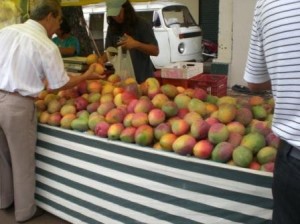
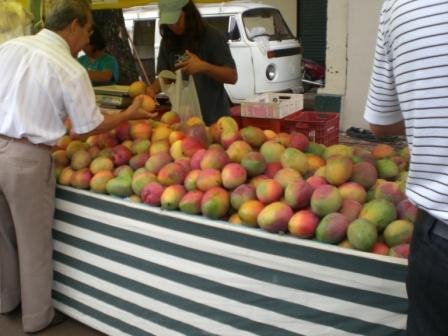
I’ve seen several different kinds of mangos here in Brazil, but have found my favorite to be the Tommy, or more accurately the Tommy Atkins variety. This variety is also one of few that are grown in Florida.
Prior to moving here, on the rare occasion that a mango made its way into my grocery cart, I had no idea what kind I was buying. However at the markets I frequent now, they are clearly labeled. I don’t notice much of a difference in flavor or texture except that the Tommy seems be just a little bit sweeter than others I’ve tried. It is simply the variety that is most often available and affordable where we are living.
So what am I getting at with all of this mango talk?
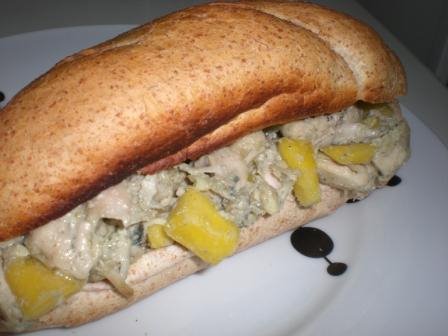
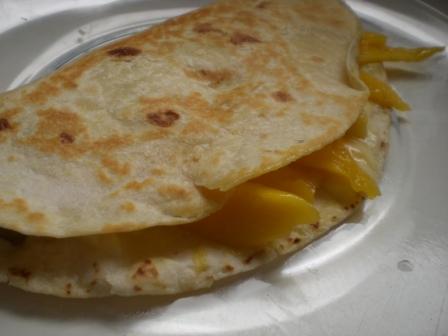
Well, I’ve decided to declare this Mango Week at Fake Food Free. I’ve got a few recipes I want to share with you. One I developed on my own, one was put together based on an idea from a former classmate and another I’ve recreated from a sandwich I enjoy at a local shop where we are living.
I know that mangos aren’t always readily available for everyone. In fact, at the moment they are a bit difficult to get here and the prices are higher. However, as the temperatures warm up in the northern hemisphere summer and mangos, or mango flavored treats, tend to go hand in hand.
So I hope you’ll come back this week to check out some of my favorite ways to use mangos and on Friday I will be announcing my very first recipe contest with a rare prize that would be hard to come by elsewhere.
I am kicking off the week by sharing my Mango Coconut Oatmeal. Sweetened by the flesh of the mango and flavored with a touch of coconut milk this recipe turns oatmeal, often reserved for cold mornings, into a breakfast perfect for warmer weather.
Mango Coconut Oatmeal 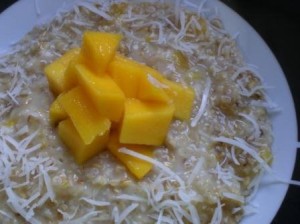
¼ cup steel cut oats
1 cup water
1 mango, chopped
1 tablespoon coconut milk
1 tablespoon, unsweetened, shredded coconut
Cook the steel cut oats according to directions and preferences. I let mine soak in the water for about a ½ hour and then on medium heat I slowly bring them to a boil. I reduce the heat and allow them to cook for about 20 minutes. At this point they reach my desired constancy and the oats still have a bit of a bite to them.
About 5 minutes before the oats are fully cooked, add in half of the diced mango. Stir the mango into the oats smashing it into more of a pulp as it is heated. Add in the coconut milk.
Transfer the oats to a serving bowl and top them with the remaining chopped mango and sprinkle with coconut.

















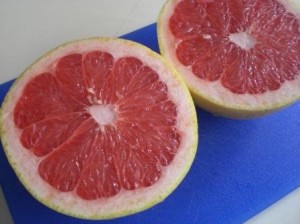
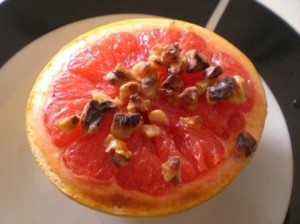
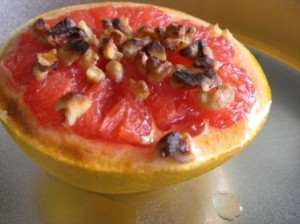 While many people begin to pucker their lips at the thought of grapefruit, I am one who is fond of this sour, citrus fruit. I can remember eating it when I was younger. Topping it with sugar or artificial sweetener was simply a part of the process. However, as an adult I’ve grown to like the tart, bitter flavor. I still like a bit of sweet with my sour, but much less than before.