Browsing Category

Fruits and Vegetables

A Match Made in Heaven – Avocados and Bananas

July 21, 2009

This post dates back to 2009 when we were still living in southern Brazil. It is where I learned about eating avocado as a sweet fruit and not a savory ingredient. I was taught how to combine avocados and bananas to make fruit salads and shakes. It was long before the avocado-in-everything craze hit the U.S.
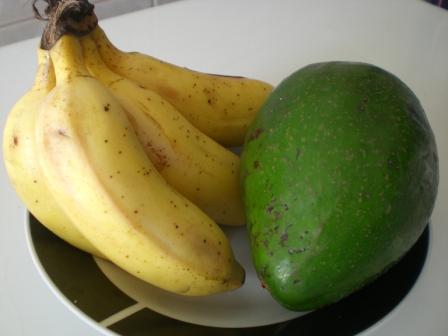
Bananas and Avocados in Brazil

I think I’ve mentioned before that around here avocados are eaten as a fruit; sweet, not savory like in many other cultures. You won’t find it on sandwiches, in salads or as a salty condiment such as guacamole. Now I still love to enjoy my avocados the old fashioned way, as I refer to it. However, I’ve been really open to the idea of eating them sweet.

At my husband’s office a popular snack is to take fresh avocado slices, sprinkle sugar on them and eat them as I would apple or peach slices. Other Brazilians have told me they cut it open sprinkle sugar on it, drizzle it with lime juice, and eat it with a spoon. I’ve tried it with just the sugar and you know what? It isn’t half bad.

When I posted about this new-to-me food phenomenon on my ex-pat blog I got a lot of responses about avocados and bananas. Soon after that I went to my favorite little vegetarian buffet down the road and one dish on the salad bar was a bowl of cut up avocados and bananas together.

Banana and Avocado Salad at a Vegetarian Lunch Buffet in Maringa-PR, Brazil

Nani, a Brazilian ex-pat living in Arizona, once commented on my blog that her dad was famous for his Vitamina de Banana e Abacate (banana and avocado vitamin). A smoothie of sorts made with avocado, banana, milk and sugar.

As interested as I was in this drink, it took me a long time to get around to trying it. In fact, I bought an avocado at the market last week and until last night it had been staring at me each time I opened the fridge door. Finally, last night after my run I gave it a try.

Oh my! I have no idea why I waited so long!

I have never had anything so creamy, sweet and slightly buttery. Words simply can’t do it justice. It is the ultimate of healthy, filling drinks. If you don’t like avocado, don’t worry. There is something that happens to the flavor once it is mixed with the banana. Honestly, I’m not sure I would identify it as avocado if I didn’t know it was in there. The best part is that it is full of potassium, monounsaturated fat, vitamin E, protein and calcium!

I froze my slices of banana first because I wanted the drink to be really cold and have a little texture. I also did not add any sugar. The banana was sweet enough. Finally, I used skim milk in my version.

Banana Avocado Vitamin | A shake recipe shared with me when we lived in southern Brazil.
Banana and Avocado Vitamin

One ripe avocado, peeled and pitted
1 ripe banana, sliced (frozen if desired)
Milk<

I used an immersion blender and a glass because that is all I have, but a blender would work well too. Blend the avocado and banana well. Slowly add a little milk at a time until you reach your desired consistency. I added about a cup. Pour it in a glass and your ready to enjoy!


************************
Or you could get involved in some of this Ice Cream Social action being hosted by Tangeled Noodle, Savor the Thyme and Scotty Snacks!


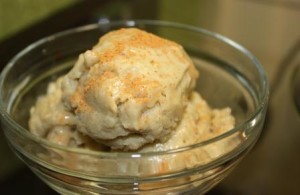
I turned the banana and avocado vitamin into Avocado Banana ice cream for my entry. I don’t have an ice cream maker on hand right now so I made via freezin’ and stirrin’ in my freezer. The fat in the avocado keeps it nice and creamy and a sprinkle of cinnamon on the top adds even more flavor. This might just be the most nutrient-dense ice cream out there!


Finally Feijoada

July 20, 2009

One of the best things about traveling or taking part in an ex-pat experience is that you get to try the real thing when it comes to the foods of the place you are visiting. This can be as close by as Memphis barbecue or as far away as pasta in Italy. While foods are imitated everywhere and a select few are exactly like the real thing, many aren’t.

I have yet to have a German sausage that was anything like those that I’ve had in Germany and Austria. There is nothing to compare to the freshness of a pint of Guinness in Ireland. No jerk chicken tastes quite like that which can you get made the traditional way in Jamaica.

I’ve mentioned before that since being in Brazil everyone always asks about feijoada, the national dish made of black beans and pork and accompanied by rice. I think this dish serves as a great example of one of those foods made elsewhere, but is never quite captured completely. This is mostly because with foods such as this we tend to take out those parts that don’t fit well with our culture.

I’ve been in Brazil two years and until Saturday I had never had feijoada. There are two reasons for this. One is because I really didn’t have any doubts that I would like it; I mean its rice and beans with meat. It really isn’t incredibly different. The second is because this is how a conversation typically goes regarding feijoada with almost every person we’ve discussed it with in Brazil.

Them: “Have you had feijoada?”
Me: “Not yet.”
Them: “Oh you have to try it. It is soooooo good.”
Me: “I’m sure it is. I’m just not too interested in the random pig parts that show up in there.”
Them: “Oh, I wouldn’t have feijoada out. I only eat the feijoada my (grandmother, mother, etc.) makes.”

Basically people tell us to go eat it, but that they wouldn’t. That really didn’t provide much motivation for me. However, my husband did want to try the real thing and I felt compelled to try it since we are living here and I wanted to be able to say that, yes, I had eaten feijoada.

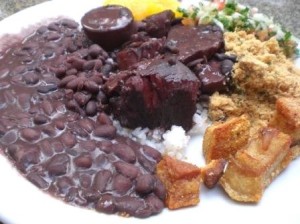
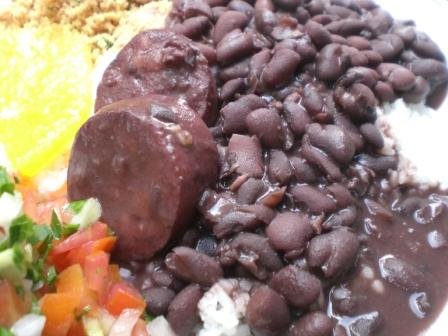
So we headed out Saturday to a local feijoada buffet. The good thing about these buffets is that they separate out all the parts. Each of these crocks is filled with a different version of feijoada with different meats, including one that was simply black beans.


I ate only the variety that had calabresa (a sausage) and a little bit of carne seca (dried meat). However, if one were so inclined you could have (pig’s foot), orelha (pig’s ear), or rabo (tail).


The truth is I may be willing to try a bite of these mystery meats, and I did some digging around with the spoon to see what they looked like. However, as I pulled up the spoon to see a big piece of flabby pig ear, I knew I couldn’t do it. A bite is one thing, but having a huge piece of it staring back at me from my plate is something I just can’t stomach.

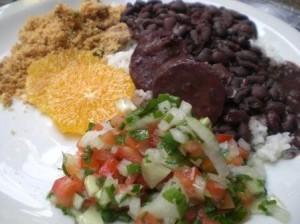
Below is a picture of my plate with calabresa and my husband’s with calabresa and carne seca. The best part of the meal for me is usually the addition of farofa (that toasted manioc flour) and the vegetable vinaigrette.

This meal is also served with orange slices to “help with digestion”. I’m not sure how technical this recommendation goes beyond that statement. However, I suspect it has something to do with the fact that vitamin C helps the absorption of non-heme iron like that found in dried beans.
I must cover the desserts as well. You know me.


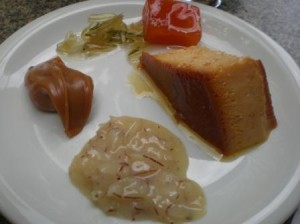
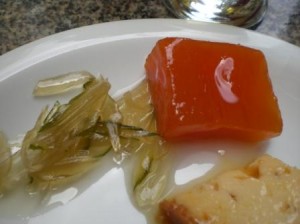
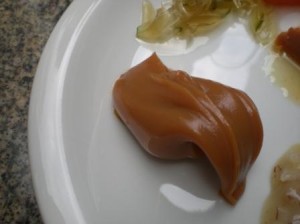
There was a small buffet of cocada (coconut in sweetened condensed milk) and pudim which is a flan. There were some candied fruits such as abobora (pumpkin) which is one of my favorites. It is candied in a ton of sugar along with some spices, namely clove. Finally at the end of the table was a huge bowl of doce de leite.


As we were eating our dessert, a thought occurred to me. Back home we tend to put those decadent things like caramel or doce de leite in the center of the cake or in the frosting all the while wishing we could dig into a big bowl of just that. Well, here they go straight to the punch and do just that! Doce de leite is eaten as a dessert all on its own.

So finally, I’ve had feijoada, and yes, it was good. However, I still feel that there are so many dishes here in Brazil that are better than feijoada. So if you visit, try it, but don’t stop there. Venture out and try Moqueca and Camarão na Moranga (shrimp and cheese baked in a pumpkin), too.

Big Papaya, Small Papaya – Same Fruit, Different Name

July 16, 2009

Brazilian Papaya and Mamão and a Papaya Breakfast Cake Recipe

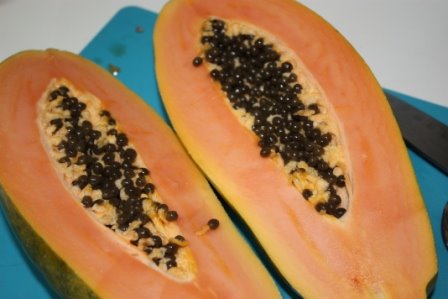
Most of us are pretty familiar with the papaya even if we don’t live in a place where they are regularly available. The papayas I had always been familiar with were about the size of a large white potato.

When I came to Brazil and started exploring all the fruits, I soon found papaya was widely available and very popular. It is the main component of salada de frutas (fruit salad) when you order it at a restaurant and I have yet to see a juice menu without it listed.

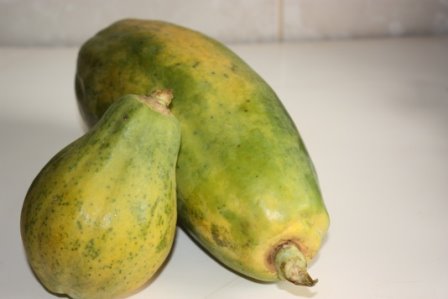
I found those small papayas I was familiar with right away in the supermarket. They are called papaya in Portuguese, too, but sometimes you will find it spelled papaia. Then I kept coming across this fruit that looked like an overgrown papaya and the signs always indicated it was mamão.

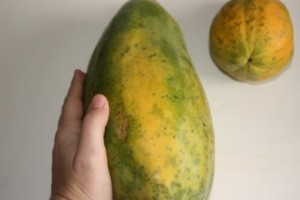
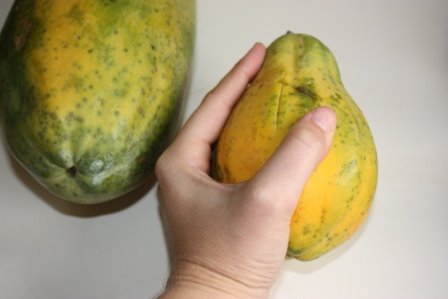
Here are pictures so you can see the size difference. The mamão is a huge fruit.


Brazilian Papaya and Mamão and a Papaya Breakfast Cake Recipe

Brazilian Papaya and Mamão and a Papaya Breakfast Cake Recipe


Upon purchasing one and trying it at home, I quickly realized it is really just a big papaya. I’ve asked around about the two fruits and that is pretty much what everyone here tells me as well. Although, the smaller papaya is supposed to be a bit sweeter. I can’t tell a flavor difference though. They look and taste exactly the same to me.


Brazilian Papaya and Mamão and a Papaya Breakfast Cake Recipe


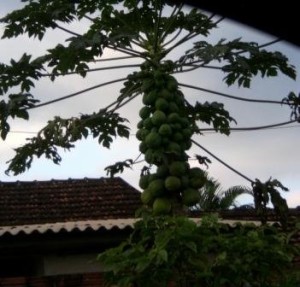
To tell you the truth, I’m not a huge fan of papaya. I enjoy it mixed in with other fruit in fruit salads and juices, but I don’t like the flavor enough to sit down to a big piece of it. Actually the most interesting thing about the fruit, the mamão specifically, is how it grows. I have been trying like crazy to get a photo because typically I only see them when we are driving. This is the best I have been able to do.


They grow on a tall, incredibly skinny tree that branches out with leaves at the top. The fruit grows in numerous bunches right at the top of the trunk.

Despite the fact that it isn’t my favorite, I do buy papaya or mamão every now and then. I consider it my duty to appreciate my access to all these good things and it usually goes into juice. However, the other day I was feeling a little creative.

I wanted to use the mamão, but wasn’t hungry for dessert. The thought of a bread entered my mind, and then, why not a breakfast cake. Who doesn’t want cake for breakfast?

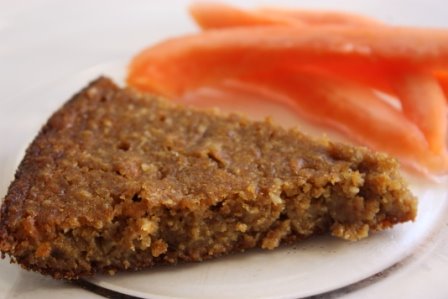
This cake is full of whole grains and is hearty and filling. The papaya simply adds moisture as the flavor of the fruit itself isn’t very strong. I will say that it is very, very buttery. In fact, I think I’ll probably reduce the butter to a 1/3 cup the next time I make it. Because it is so moist, you’ll want to store any leftovers in the fridge.


Papaya Breakfast Cake Recipe


Papaya Breakfast Cake

Makes a 10 inch round cake

½ cup butter, softened
½ cup mascavo sugar (unrefined cane sugar)
2 eggs
1 cup papaya or mamão, pureed
¼ cup steel cut oats, soaked for at least a half hour and drained
½ cup whole wheat flour
1 tsp baking soda
½ tsp salt

Cream butter and sugar, then mix in eggs. Stir in papaya and mix well. Next stir in the soaked oats and stir until combined. Finally add in flour, baking soda and salt and stir to combine all ingredients.

I used a lightly greased 10 inch round, glass baking dish. However, given the amount of butter I think I could have gone without greasing it. Any square pan would work fine too. Bake at 375 degrees F for about 25 minutes, until edges are browned and center is baked through. Allow to cool about 5 minutes, serve warm or at room temperature.


Thanks for reading! All images and content are the property of Fake Food Free and Lori Rice unless otherwise stated. Please do not republish full recipes and images without written permission. What is okay? Feel free to Pin images, share links to my posts or share the photo in a round up post with the title of this recipe and a link back to the post. Confused about copyright and food blogs? Here is some helpful information on Recipe Attribution. If you want to use a photo or full recipe, just ask. I’m sure we can work something out.

Zucchini Quiche with Whole Wheat Crust

July 9, 2009

There was a time when the egg yolk rarely made it into my diet. I hastily followed the crowd when this food made the spotlight for being high in cholesterol. The truth is I enjoy egg whites just as much as the whole egg. I also tend to enjoy just eating the white and not the yolk when eggs are hard boiled.
However, I disliked that nagging voice in my head telling me that I shouldn’t be enjoying the whole egg on rare occasions. Fortunately, as seems to be happening with a lot of foods previously labeled unhealthy, the nutrition news changed and eggs came back as being a food now known for its healthy attributes which outweigh any nutritional shortcomings.
I gradually started eating the whole egg again and said good bye to that nagging voice. I knew my great grandfather couldn’t have been all wrong considering he lived into his 90s and ate almost a dozen fresh from the farm eggs a day.
The main thing that got my attention concerning health and the egg was choline. Egg yolks are one of the richest sources of choline, which is part of the B vitamin family. The most important benefit for me being that it is necessary for brain health.
I have eggs often and many times I will include one yolk and multiple egg whites when I just want the protein, but don’t want a lot of calories. The whole egg has about 70 while the white has about 17. That way I can still benefit from the choline and have a filling meal with a lot of protein.

One of the best ways to use whole eggs is in a quiche. I have always enjoyed quiche with its buttery crust and airy texture. You can also fill it with all kinds of vegetables and flavorful cheeses which is a huge bonus.

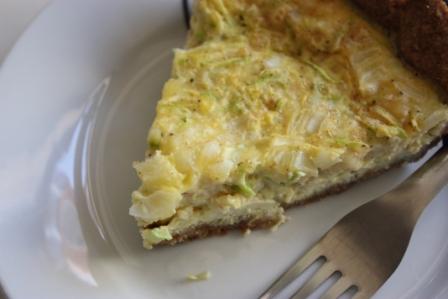
Earlier this week I had a zucchini that needed to be used up so I decided shredding it for a quiche would be a great way to enjoy it. I also had some smoked provolone cheese which is one of the better cheeses I find here and offers so much flavor to many of the things I make from pizza to a green salad.
But what about the crust? I wanted something partially healthy, but still rich and buttery. I haven’t had access to a rolling pin for two years. It is tucked away in a storage unit in the US, so I’ve become a big fan of pat-in- the-pan crusts. I decided to take the one I regularly use from the Joy of Cooking and make it whole wheat.
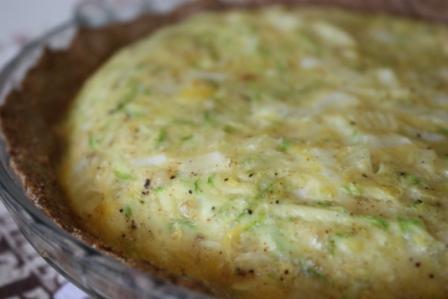
It turned out great! Still buttery, but with a crumbly texture and a flavor that really paired nicely with the eggs, veggies and cheese. In fact, I think I am going to attempt at making a sweet version of it soon for a pie adding some spices such as cinnamon and nutmeg.
Zucchini Quiche with Whole Wheat Crust

1 ½ cups whole wheat flour
½ tsp salt
½ cup butter, softened
Milk
¼ cup onion, finely chopped
¾ cup zucchini, shredded
1/3 cup smoked provolone, shredded
4 eggs
1 tbsp flour
1 cup of milk
½ tsp salt
¼ tsp black pepper
½ tsp cumin
½ tsp hot paprika
Preheat the oven to 350 degrees F. In a bowl mix together whole wheat flour and salt, cut in the butter and mix with a fork or pastry blender until butter is incorporated and dough is crumbly. Slowly add milk, one tablespoon at a time until the mixture forms a dry, yet cohesive dough. Press the dough evenly into bottom and sides of a deep, 9 inch pie pan.
Sprinkle the onion, zucchini and cheese evenly over the crust and set aside.
In a bowl or in a blender combine the eggs, flour and milk. Mix well with a whisk or in the blender. Add the remaining seasonings and whisk or blend again until the mixture is somewhat frothy. Pour the mixture over the vegetables and cheese in the pie crust. If your pan is not deep enough you may want to cut back on the milk to make less egg mixture. Leave at least a ¼ inch of crust visible around the edge.
Bake for about 45 minutes to an hour. The egg will rise a bit and the top should be slightly browned and the center set. Allow to cool for five minutes, slice and serve. Makes six to eight servings.

Tropical Wheat Berry Salad

July 1, 2009

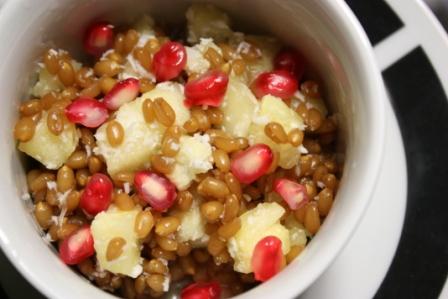
I’m still on a bit of a wheat berry kick. I brought some back with me when I returned to Brazil and lately I’ve been thinking about what I could do with them. After picking up a pineapple and then splurging on a pomegranate at the market the other day, I finally had my answer.
I wanted something sweet, not savory, for this experiment and I thought I could pull it off with a wheat berry fruit salad using tropical flavors.
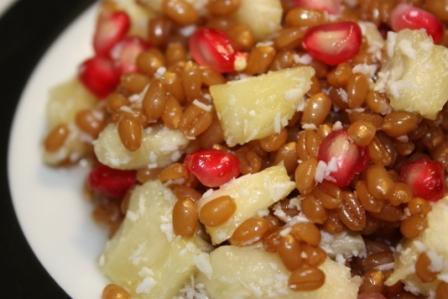
I simply combined honey, lime and coconut for a dressing. Tossed some diced pineapple with cooked and cooled wheat berries. Pomegranate arils came about for color.
I really enjoyed this sweet twist on a healthy grain. It’s great for a cool, but hearty breakfast on a hot morning or maybe a new salad to take to a picnic.
Tropical Wheat Berry Salad
½ cup dry wheat berries
1 ¾ cup water
1/3 cup pineapple, finely chopped
2 tbsp honey
Juice of two limes
2 tbsp finely ground coconut
¼ cup pomegranate arils
I cooked the wheat berries according to package directions which was ½ cup in 1 ¾ cup of water. Bring to a boil, reduce heat and simmer, covered, for about an hour until tender. Drain them if necessary and let them cool.
Once cool, toss the pineapple with the wheat berries. Whisk together the honey and lime juice. Taste to determine if you need more sweet or sour depending on your preferences. Whisk in the coconut.
Pour dressing over the wheat berries and toss to coat. Garnish with the pomegranate.

Cauliflower & Mandioquinha Soup

June 26, 2009

I’ve been trying to find a bit of balance lately. I’m talking about the fact that it is winter here. Well, more like a Kentucky October, but they call it winter. Despite the fact that temperatures aren’t plummeting into the 30s, I’m still having overwhelming cravings for cold weather foods. At the same time for many of you, it is summer and a darn hot one from all info I’m getting.

So as you can imagine, staying in-season with cooking and food posts is a bit impossible. Or is it?

This week I’ve been trying to think about my favorite recipes (or ideas for new ones) that may comfort me, but use all that wonderful produce that many people are harvesting from the garden. So yesterday this Golden Potato-Cauliflower Soup came to mind. I’ve been making it often ever since I found it in Health Magazine in 2004.

The good news is that it uses garden favorites, but is suitable for winter-warming. I’ve changed it a bit over the years and yesterday I decided to use it with some mandioquinha I picked up at the market last weekend.

You remember it, right? That golden, sweet root vegetable native to South America also called the Peruvian parsnip, batata baroa or arracacha. I’ve decided I need to overdose on it for the next three months while I’m still here, by the way.

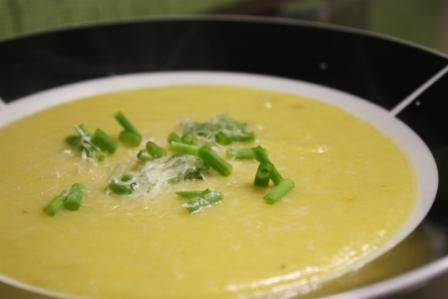
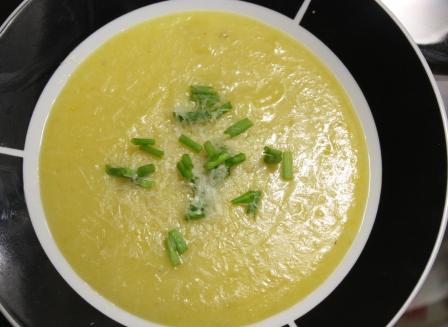
The substitution worked wonderfully. It was the potato version taken up a notch, smooth and creamy, comforting yet still light. While I know most of you don’t have access to it, I started thinking about all the other root veggies that might work well in this recipe. Turnips, red potatoes, parsnips? I don’t know. It may be worth a try.

Cauliflower & Mandioquinha Soup
Adapted from Golden Potato-Cauliflower Soup, Health 2004


1 Tbsp olive oil
2 cloves garlic, minced
½ cup onion, diced
1/3 cup celery, diced
2 cups mandioquinha, chopped (or your root veggie substitute)
1 medium cauliflower with broken into small pieces
Salt and pepper to taste
3 cups chicken stock
½ to 1 cup milk
Chives and grated parmesan for garnish

Heat olive oil in a soup pot and saute garlic, onion and celery for 2 to 3 minutes. Add madioquinha and cook for about 3 more minutes. Add in cauliflower and cook and additional 7 minutes. Veggies should be starting to brown a bit at this point, or at least getting tender. Salt and pepper to taste now or you can wait until the soup is combined.

Add three cups of chicken stock. This should almost cover the veggies, but not completely. Bring to a boil, reduce heat, cover and simmer for about fifteen minutes or until the vegetables are very tender.

Turn off the heat and use an immersion blender (or transfer to a standard blender) and blend all ingredients well, leaving no lumps. Turn the heat back on and stir in ½ to one cup of milk depending on desired consistency and heat through.

Transfer to bowls and garnish with chives and cheese. Take pictures. Oh, wait. You don’t have to do that one. Silly me.

Serves about 4.

Apples, Carrots and Zucchini in One Tasty Bread

June 2, 2009

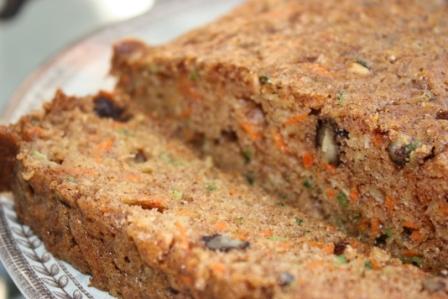
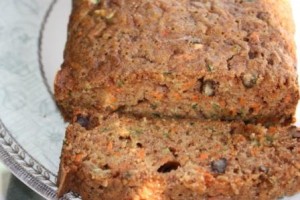
I am a huge fan of zucchini bread. What better way to enjoy a vegetable, right? While I’ve also had apples in bread as well as carrots, I can’t say I’ve combined them all together before. Well, until yesterday.
We came across this recipe for Garden Harvest Cake in the April 2009 issue of Cooking Light. My mom and I (well more my mom than me) decided to give it a try. Since we didn’t change the recipe at all I will leave it as link for you to check out.
Although the recipe says it is a cake it has every characteristic of a quick bread. I always come across recipes that call for applesauce instead of oil and I’m never incredibly impressed with the results. However, as opposed to applesauce, this recipe uses a fresh Granny Smith apple to cut the amount of oil a bit and the results are fantastic! You will end up with a moist, tender bread full of cinnamon flavor with the slight crunch of toasted walnuts. A great breakfast for a hot summer morning.

Asparagus Pizza with White Garlic Sauce

May 28, 2009

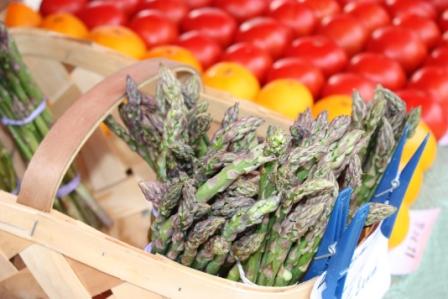
Beautiful green stalks of tender asparagus have been plentiful around here. When it comes to my list of favorite vegetables unfortunately asparagus resides at the bottom of the list. I don’t exactly dislike it. Well, okay, maybe at one time I disliked it, but now it just isn’t my veggie of choice.

When it comes to nutrition there is really no reason why this spring vegetable shouldn’t be enjoyed. That is the case with most vegetables though, right? Our bodies need that produce and asparagus is full of vitamin K, folate, vitamin A and vitamin C.

This is the first year that I’ve had the chance to really experiment with it, though, and I’m finding that I enjoy it a bit more with each dish. For example, my brother threw some on the grill the other day and it was fabulous. I didn’t put a thing on it; straight off the grill and into my mouth. Excellent.

Tonight I decided I would try topping a pizza with some asparagus my dad had brought in from the garden yesterday. I combined roasted garlic with a basic white sauce. Then spread this over a wheat pizza crust and topped it with steamed asparagus and mozzarella cheese.

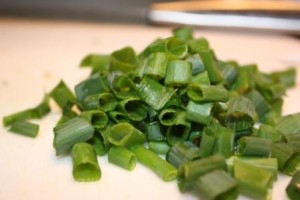
My original plan was to add caramelized onions, but I opened the fridge to find that we were all out. So I decided to use another garden treat and chopped up some scallions. I sprinkled these on the pizza as soon as it came out of the oven.


I find white sauce pizzas to be a pleasant change from the standard and this was no exception. Turns out asparagus is quite a tasty pizza topping.

Spring Asparagus & Scallion Pizza with White Garlic Sauce

1 head of garlic
Olive oil
1 wheat pizza crust
1 cup asparagus, chopped into medium sized pieces
1 tbsp unsalted butter
1 tbsp flour
1 cup milk (chicken stock would work too)
Salt and pepper to taste
1 cup mozzarella cheese, shredded
½ cup scallions, chopped

Preheat the oven to 375 degrees F. Slice off the top 1/3 of the head of garlic. Place on a piece of aluminum foil and coat with olive oil. Wrap in foil and roast for 45 to 60 min. Work on the rest of the pizza as it bakes and set aside when finished.

Steam the asparagus just until tender and bright green. Set aside.

Melt butter in a small sauce pan and sprinkle in flour. Use a whisk to stir constantly creating a roux. Slowly pour in milk as you whisk and allow mixture to cook until thickened, stirring constantly. Once it reaches your desired consistency (preferably a thick sauce) squeeze the head of garlic into the sauce. Whisk to break up garlic and then add salt and pepper to taste.

Spread sauce on crust and sprinkle with half of the cheese. Top with the asparagus and the remaining cheese. Bake until cheese is melted and bubbly. When I make my crust I partially bake it before adding the toppings so it takes about 15 additional minutes for the pizza to finish.

Once out of the oven top it with the scallions and serve.

Is Trying Enough?

May 21, 2009

When visiting DC with my family we found ourselves browsing around the Museum of Natural History at lunch time. I typically don’t prefer cafes connected to large tourist attractions, but unfortunately the café in the museum was our only option in the area so we ate there.
As we entered the line to go in, I was greeted by some running TV screens which stated that the cafeteria used locally grown ingredients. When we got inside I noticed that they were selling organic fruit. Although I don’t consider organic the end all and be all when it comes to my produce selection, and the price was pretty hefty, I did take the offering as a good sign.

Then we got to the drink station. Hello Coke! There was water available under the lemonade (although I’d paid almost $3 for the cup) and some unsweetened iced tea (not brewed) in the fountain so at least there were a couple options.
I complained to my family how frustrating it is that establishments boast about local and organic and yet sell out to soda companies. After my venting, I started to think about why this upset me so much.
Well, we talked a week or so ago about how in-your-face soda is, so that was one thing. The other thing was that they seemed to be proud of their healthy, environmentally friendly food practices, but ignored that when it came to beverages. Then I came back to the thought – Well, at least they are trying.
This then brought me to the question – Is trying enough?
I ask myself this question often when it comes to my food choices. I’m definitely changing – making more environmentally friendly choices, increasing my awareness about where my food comes from and what processes it goes through, and eliminating fake foods from my diet.

I am far from perfect, however. Although, I’m getting closer I doubt I will ever get to the point where every piece of beef I put in my mouth is grass fed and every piece of produce I consume is grown under ideal farming practices. I do see stopping at a famous or historic, local burger joint during my travels in my future from time to time.
It is easy to blame some of this on our society. In order for everyone to make these changes our society and the foods we are offered, say, when we are out to eat need to change too. I take full responsibility for my own actions, but if there is no place around when you are traveling that sells the good stuff you are used to buying at home you are kind of out of luck. While you certainly don’t have to eat fast food, there are times you are forced to make exceptions.
So then I consider if I feel that trying is enough for me, why do I feel the need to be so critical of eating establishments who are not perfect, but trying as well? That doesn’t seem fair.
I’m not always this critical. Usually if there is a healthy option I’m happy. However, as my knowledge grows and I strive to change my diet I find the temptation to be overly critical grows stronger as well.
Despite my attempts to give myself and the places I eat a break, I still wonder if trying is enough. In some cases I think it is. Small changes by many people can make a huge difference. However, if we always use little excuses like – well, I really like that even though it is a fake food or I’m too busy to make my own food – then we aren’t facilitating the changes that need to happen as a society which will result in the consumption of more nourishing, whole foods that we can get anywhere and everywhere.
So right now, I do think trying is enough, but long-term I wonder if I’ll ever reach perfection in this area or if that is even what I’m striving for.
Do you think trying is enough?

New Kind of Mango

May 20, 2009

I’ve been having a wonderful time visiting with old friends during my time in Kentucky. This week I stopped by the house of a very good friend to meet her new baby girl. Well, not exactly new. She’s nine months old and this was my first opportunity to meet her!

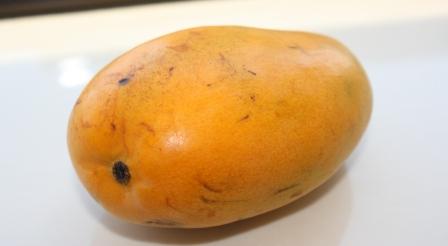
While we were talking my friend started to tell me about Champagne® Mangos. I had never heard of them. Being the sweetheart that she is, she gave me one to try. She described them as incredibly unique and addicting. She’s only found them at two places in town (Whole Foods and Meijer) and they are only available for a couple months out of the year.

I combined what she told me with a little of my own research about the Champagne® Mango. First of all the term “Champagne” is a registered trademark. Kind of interesting for a fruit. They are grown in Mexico and claim to be different than other varieties of mangos.

From the description on the web-site:

It has a spicy-sweet flavor, buttery texture and, unlike other varieties of
mangos, it is free of annoying seed fibers.

We have a smaller variety of mango in Brazil which I don’t know the name of, but I didn’t find it too exciting and decided to stick with the Tommy variety. So I was interested in this Champagne® Mango, but a bit skeptical of its ability to be so unique.

Well, I ate it in the hotel room and if you’ve ever tried to do this without a knife I wouldn’t recommend it. However, the mango was very ripe and I was actually able to open and scoop it out with a spoon.


The fruit meets the description in every way! There is this underlying spicy flavor that hangs on your tongue just a bit as that sweet familiar mango flavor takes over. The inside is so creamy. It wasn’t fibrous like many mangos tend to be. Each bite literally melted in my mouth.

This is a mango I wouldn’t dream of using in a recipe. It deserves to be eaten fresh to appreciate its texture and flavor. I’m so hooked I’m going to swing by Whole Foods (we don’t have one in my hometown) before I leave here to try and get some for the rest of my stay in the States.

Have you tried this variety of mango? What did you think?

Generated image

So of course all of this mango talk comes just in time for your last reminder about the Mango Challenge. Thanks so much for all the amazing entries so far! If you haven’t submitted your recipe, you still have time. All entries are due by Friday, May 22nd at 12:00pm CST. I’m happy to say all the goodies from Brazil made the trip well in my suitcase. I can’t wait to share them!

Want to create beautiful food and product photos that you can't wait to share?!
Discover your style, control the light, and shoot using the tool you know how to use (yes, your phone included). Learn about free resources, Live Q&As with Lori, and online courses you can take from anywhere in the world!
We respect your privacy. Unsubscribe at any time.