Monthly Archives

January 2010

Links to a Healthy Weekend

January 10, 2010

What a fast weekend! I can’t believe it is already Sunday evening. What a great week though! Despite the fact that I simply can’t get warm, two years without a true winter has me jumping for joy with the snow we’ve gotten around here. Kentucky can be hit or miss when it comes to a snowy winter, but with three or four inches on the ground and relatively clear roads we are enjoying some beautiful winter scenery. We even went out for a drive yesterday and saw a few buffalo braving the cold. (I know they look like they could be just about anything, but I promise, they are buffalo.)


All day yesterday was spent house shopping. We found one we liked, but we’ll just have to see how things progress. However, I will say the kitchen was beautiful! The most important part of the house, of course. Then to top off the excitement we picked up our first order of pork, beef, chicken and eggs from a local farm. Pike Valley Farm produces grassfed/pastured/natural foods. I can’t wait to share more about it in a later post, maybe this spring.

Today I continued my journey on the half marathon training path getting in four miles on the treadmill this afternoon. I haven’t braved the cold yet, but I will have to once the race gets closer. I do have my hopes up that it will at least be in the 40s by the end of March for the actual event. I figure no reason to get acclimated to zero if I don’t have to!

Below are a few of the things I enjoyed reading this week. How was your week?

Agriculture Society shared the post Proof that Real Food Doesn’t Have to Cost a Bundle. A great read that outlines the cost of meals made with real, naturally produced foods. I love reading posts like this. Like everyone else, I get caught up in feeling that we can’t afford to eat this way, but the truth is we can. We just have to adjust our budget, our views and perhaps sacrifice a few minor things, but it’s definitely worth it.

Safety of Beef Processing Method Is Questioned was an article last week from NYtimes.com and likely something you don’t want to read while you are eating. It may turn your stomach a bit, but it is an eye opening read and it makes me incredibly happy that I just bought 4 lbs or ground beef from a local farmer!

Kiss My Spatula posted some gorgeous Homemade Goat Cheese. It made me want to run out and buy some milk or perhaps even my own dairy goat!

Is the fat acceptance movement bad for our health? was a thought provoking article on CNN.com. I would love to hear your opinion.

The Dabble had a great recap post of a recent trip to Purdue University’s campus including eats and drinks. My husband and I are both alumni and are headed back up for a basketball game in February. We are really excited to visit some old favorites. You’ll also love the Chocolate Torte Cake recipe in the post!

On Go Galavanting I posted about a cool little bed and breakfast in Colorado called the Fresh and Wyld Inn offering SOUL food cooking classes (sustainable, organic, unprocessed and local).

If you still want to learn more about Antigua, I posted more about my non-food experiences on The 3 Star Traveler.

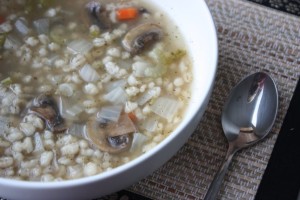
Making one of my first attempts to stick with my New Year’s commitments, I made the Mushroom Barley Soup from Two Peas and Their Pod this week. It was delicious!

Expanding My Tea Knowledge: Pu-erh

January 8, 2010

This time of year I find that in order to stay warm I must always have a steaming mug of something in hand. It feels as though if I’m prevented from sipping a warm drink, I risk freezing up into an ice cube entirely.

You know I’m a huge coffee fan, but that doesn’t mean I’m anti-tea. In fact, I find that I must nip the coffee drinking in the bud by midmorning or I may overdo it on the caffeine. Too much of a good thing and all. So this only means that my tea drinking drastically increases in the winter to fulfill this ever present need to sip a cup o’ warmth.

I’m not a tea expert by any means, but I have had the opportunity to try several varieties. A few years ago my when my husband went to Beijing for work, he brought back flower tea and green tea which resulted in my first Chinese tea experience. While visiting Hong Kong in October we drank Jasmine tea with every meal and brought some back with us to enjoy as well.

My most interesting tea experience, however, came about last September, just before we left Brazil. The last few months of my time there I had the opportunity to meet and hang out with a fellow expat. Miranda is from London and married a Brazilian (Paulo) who happens to be from the same area we were living. They had settled there for a year or two while deciding their future plans.

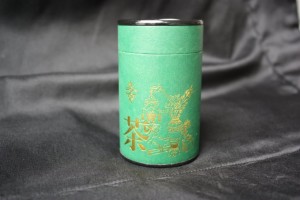
Last summer, instead of a big wedding they set out on a round-the- world trip, and one of their stops was China and a tea tasting house. When we were able to meet after their trip Miranda presented me with this.


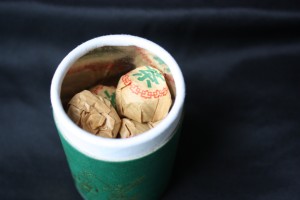
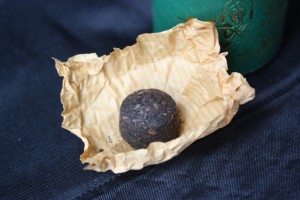
A pretty canister of Pu-erh tea. At that point I had never heard of it or seen it before. She let me know about its growing popularity and my excitement about having the opportunity to try it began to grow.


Pu-erh tea (also spelled as puerh, puer, pu-er and pu’er,) comes from the Yunnan Province of China from a town of the same name. It has over 1700 years of history and I’ve learned that it is quite the prized possession especially if it has been aged well which in some cases can be up to 65 years!

It comes in two varieties, sheng which is green and known as raw and shu which is black or sometimes referred to as cooked. Both start out the same way as maocha and then are preserved/processed differently.

For sheng, the maocha is lightly steamed and pressed into tea cakes. The microbes that remain in the tea result in the product undergoing a natural fermentation process as it is aged. Often left to age for at least 8 to 10 years the pu-erh turns from raw to cooked during this time. It is known for becoming smoother and less bitter as it ages.

For shu, the maocha is put into piles, spread out and wetted. Then it is covered to create something similar to a compost pile. From what I’ve read the technique for making the tea in this way is very detail oriented. It must be turned at the appropriate time and frequency to achieve the correct flavor and fragrance. Once the tea is ready, it is lightly steeped and pressed into cakes like the sheng. This method was developed to speed up the process of making pu-erh tea, but the sources I found didn’t indicate just how much more quickly the final product results.

I think it is well established that tea in almost any form is good for us. Well, okay, perhaps not the sugar-laden sweet tea (pronounced swate-teh) that we have in the south. But you know what I mean – oolong, green, black, jasmine, chai – they all have their individual health benefits to offer. Pu-erh is no exception.

Of course, as we often do with most ancient products consumed by other cultures, pu-erh tea has become a bit of a fad weight loss aid. I’m not commenting on that simply because I get tired of how my society must grasp perfectly good, real foods and turn them into money-hungry weight loss campaigns.

I did learn, however, that pu-erh tea has been found to be successful at lowering LDL cholesterol while raising HDL cholesterol (1). In addition, one study found that the tea has antioxidant and lipid-lowering effects and could potentially be used to reduce cardiovascular disorders (2).

However, do keep in mind the studies were done with rats consuming the leaves and extracts of the tea. I always pay attention to this because in grad school I did a research review of green tea. Of course there are health benefits, but most studies used extracts that would be equivalent to drinking 10 to 12 cups a day! Kudos to all the researchers out there who strive to evaluate foods as we would actually consume them.

The good part though is that drinking teas can be good for you overall. That is why I’m such an advocate for eating real, natural food and not worrying about the specific amounts, percentages and benefits. Healthy foods are going to work together to make you healthy overall. It doesn’t have to be so complicated.

So what type of pu-erh tea did I get?

I actually don’t know. Perhaps there is a way to tell by the label, but not speaking any form of Chinese, I’m clueless. Although I would suspect it is shu, as I’m sure the varieties aged the traditional way are likely untouchable regarding price.

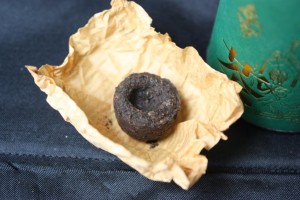
I can tell you about the flavor though. The tea has a very rich, dark flavor, almost woodsy and the dark leaf that results as it steeps remind me of coffee grains. The overall flavor is incredibly complex as the production of the tea would indicate.

So if you come across real pu-erh tea, do try it. Not only does it warm me up, but it is very different from any tea variety I’ve experienced before.

Have you ever tried pu-erh tea, or do you have more details about it you can share?

References:

Tasting Antigua

January 4, 2010

I wrote this post back in 2010, but we have since returned to beautiful Antigua! We hired Roger, the tour guide mentioned in this post, once again and had another great trip exploring this stunning island!

IMG_5415

“What would you like for lunch?,” our guide asked.

“Something local,” my husband and I said in unison.
 
I think our guide was a little surprised. There are a lot of food choices available on the island of Antigua, especially considering its rather European history. I had, however, read up on some of local, native foods of island before our trip and had been looking forward to trying them for months.
 
For the past several years we’ve taken a vacation in the Caribbean the week before Christmas. This year we made our first visit to the island of Antigua. We stay at Sandals resort, which we love, but as we’ve traveled more and more we find it important to get off the comfy resort and learn more about the places we are visiting. That, of course, also means having some local food.
 
This year we hired a private driver, a local named Roger. He took us out driving for the day and taught us so much about the history of his island. Probably due to the focus of my questions a large portion of what we learned was focused on food. For starters, he showed just about every fruit plant that grows in the area. I tried to make a list of the things we saw, but I’m sure I missed a few.

 

Sorrel, breadfruit, pomelo, lemon, lime, cacao, guava, passion fruit, pomegranate, custard apple, pineapple, banana, soursop, mango, avocado, ackee, papaya, tamarind and coconut.
That’s a lot of tropical fruit for one small island! In fact, Roger told us that many fruits such as the lemon and mango simply go to waste because they aren’t used in a lot of local cooking.
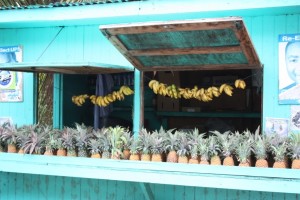


Midday we passed a few roadside stands selling fresh fruit, the highlight being the Antiguan Black Pineapple. Roger assured us that it would be the sweetest we’ve ever tried. I was skeptical considering all the delicious pineapples we were able to try in Brazil, but Roger was spot on. The flavor rivaled those of South America.
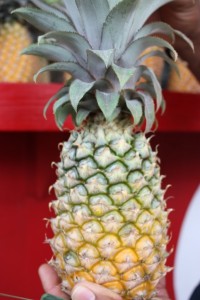
 

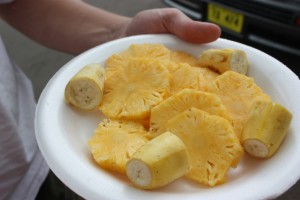
As you can see the pineapple isn’t black at all. It is small in size with a dark, golden skin when ripe. The owner of the stand we stopped at prides herself on only selling the Antiguan Black Pineapple. We got a plate of the pineapple and some finger bananas (as they were being called). The bananas were much like the banana maça we used to get in Brazil, but I’m not sure that they are the exact same variety. What a plate of nature’s goodness!

Roger came across as a natural, unprocessed food advocate and we had a lot of interesting, informative conversations throughout the day. He told us that because Antigua is so small many foods are imported. That also means that many food trends come along with it. For example, he said when he was growing up they made their own sea salt harvesting it from the water around them. Then all of a sudden they started receiving shipments of table salt and it began showing up in stores.

They began eating that type of salt being told that it was better, likely because of the iodine. Of course, today the focus is back on sea salt because of its beneficial mineral content. So what they had done as kids turned out to be the best practice.

I think we can all relate to that. Food trends whether for health or taste always seem to upset cultures and often healthy practices whether it be a large landmass or a small island.

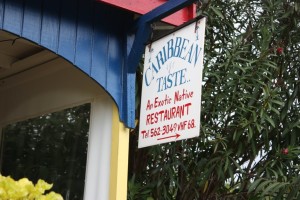
For lunch we ended up at a small restaurant called Caribbean Taste. The best way to describe it was a home-slash-restaurant. Family and friends came in and out while we ate and groups of women sat in the main area of the building eating and preparing more food for cooking.



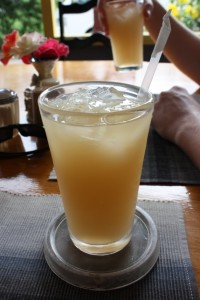
I was hoping to get to try the sorrel drink which is made around the holiday season, but they had not made it that particular day. Instead, we got some homemade ginger drink. This stuff was amazing. I’ve had ginger beer before which is carbonated, but this was like lemonade, but made with ginger instead. It was sweet with that spicy burn specific to fresh ginger root.


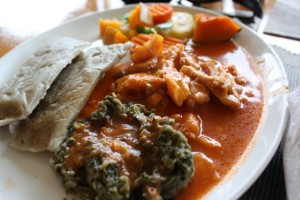
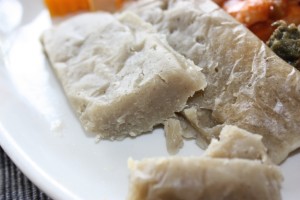
When I found out there was only one order of Ducana left for the day I quickly decided what I wanted. I had read about it prior to our trip and Roger explained it to us on the tour as well. Made of sweet potato, flour, sugar, coconut and spices it is a dumpling steamed in a banana leaf. Mine was served with salted cod in a red sauce and chop-up which is a mixture of veggies most prominently spinach. A delicious sweet and savory combination.


My husband tried the curried goat. Okay, I did try it. Since I had pet goats growing up and my parents still raise them I have a really hard time enjoying goat as a meal. However, I do understand the fact that it is a common protein source for many cultures. So in the spirit of being open to foods and culture I tried a bite.
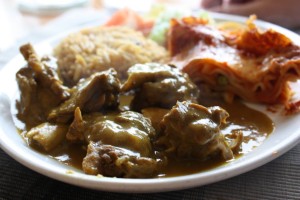
I can’t say I loved it and that had nothing to do with the fact that it was goat. It reminded me of a roast like my mom used to make when I was growing up. Kind of fatty, but with tender yet slightly chewy meat. The flavor of the sauce was great, but I didn’t enjoy the meat, however, I think my husband would order it again for sure.

Along with the great food out on the island, the food at the resort wasn’t too shabby either. I will say we were disappointed that more local foods didn’t make the menu. We talked to Roger about this and he expressed that he wished the people of Antigua would demand that local foods be used on the menu. I’m speaking of local dishes/recipes here, not necessarily local ingredients. Apparently in Jamaica it is a priority so although you may not have something truly authentic it is likely you will find a version of escovitch fish, jerk chicken and ackee and salt fish even on the menus of all-inclusive resorts.

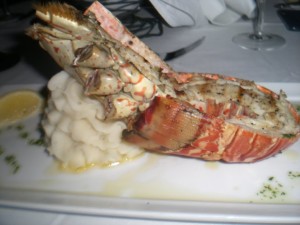
The one exception was the Caribbean rock lobster for which Barbuda (part of the same country as Antigua) is known. We had grilled lobster many times during our visit. I also had a bit of fungi for breakfast one morning which is a cornmeal similar to polenta. This version was formed into patties or cakes and served with okra.

 
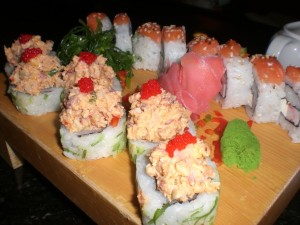
Sushi with spicy crab
 
 
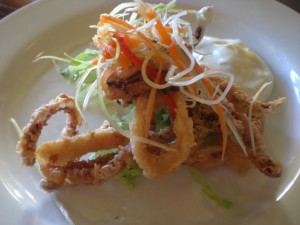
Fried Calamari


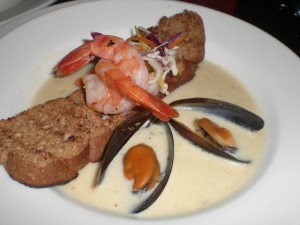
Seafood Chowder
 
 
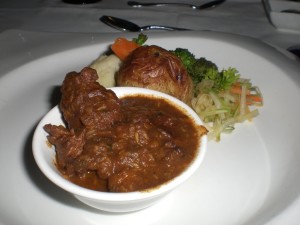
Curry Lamb


Paradise Punch from the swim-up bar



Pumpkin Cheesecake



Deconstructed Tiramisu



I love foods of the Caribbean and Antiguan cuisine was no exception. If you find yourself there, head out and explore the island and eat some fantastic food while you’re at it!


Need a guide when you are there?
Our day with Roger was fantastic!
Roger’s Taxi & Tours
(268) 764 -6331
rogertaxitours (at) gmail (dot) com


Links to a Healthy Weekend & Winner!

January 2, 2010

Happy 2010!

Even though I didn’t get up many posts this week, I did do some reading and I couldn’t let the first weekend of a new decade go by without putting up a links post. Not to mention the fact that it is 01022010. The date today is the same whether you read it forward or backward. Thanks to Twitter for that fun fact.
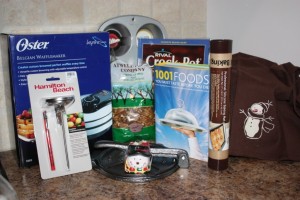
I’m usually not one to go on too much about the gifts I received for Christmas, but I got some really exciting foodie stuff this year and I just have to share my excitement with you. My family went overboard for Christmas. I got a jumbo muffin pan (perfect for mini-meatloaves), a silicone baking mat, a basil plant, a crockpot cookbook and a 1lb bag of pecans (my Mom’s great with the food gifts). I also got a candy thermometer which has me already planning out what I’m going to make for Valentine’s Day.
To top it off I got a book I’ve been wanting for a while now, 1001 Foods You Must Taste Before You Die. It lists fruits, veggies, fish, meats and cheeses from all over the world. It is so fun to go through and see what I’ve already tried during our travels. There is a lot more out there to explore!

Since I was traveling during my birthday in October I also got two belated birthday gifts from my brothers. A new waffle maker perfect for weekend breakfasts and a tortilla press. I can’t wait to start making our tortillas from scratch!
Okay, enough about me. Here are a few of my favorite reads from the week.
Top 20 worst food trends of the decade from the Denver Food Blog will give you a good laugh. Hopefully no sensitive foodies out there will be offended!
Got Passport asks Are YOU part of the problem? This is a very straightforward post that will lead to evaluate your efforts to better your health and the environment. I made me give some thought to those times that I give excuses.
Heaven & Earth Farm seeks apprentices according to a post on the Sustainable Food Jobs blog. I just had to pass this one on. It sounds like such an amazing opportunity.
*********************************************************

And now, for what many have been waiting for – the winner (as generated by random.org) of the Tropical Traditions 32 oz. jar of Gold Label Virgin Coconut Oil is…..

Anonymous commenter, Angie!!! (Thanks for leaving your email address!)
Congratulations! Email me at lori (at) fakefoodfree (dot) com with your name, mailing address and email address. I will send it on to the company and they will ship the coconut oil directly to you.
Thanks to all who entered and congrats again to Angie!

Photo of Macy the pug on Christmas morning.
Want to create beautiful food and product photos that you can't wait to share?!
Discover your style, control the light, and shoot using the tool you know how to use (yes, your phone included). Learn about free resources, Live Q&As with Lori, and online courses you can take from anywhere in the world!
We respect your privacy. Unsubscribe at any time.