2 T sweetened condensed milk
2T coconut milk
3T whole milk
¼ cup chopped mango


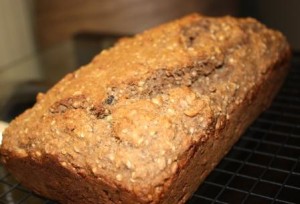
Oats, wheat berries, ground flaxseed, sesame seeds and walnuts. These are a few of the things I had sitting around the apartment that were begging to be used. When I stopped by the supermarket on Monday and walked past the beer aisle I caught a glimpse of what all these ingredients had the potential to become – whole grain beer bread!
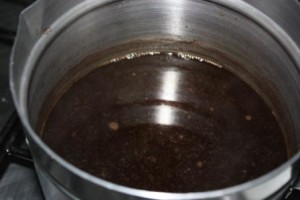
Much of the dark beer here in Brazil is Malzbier. It’s very low alcohol and some compare it more to root beer than traditional beer. I used to enjoy it when we first arrived, but it is rather sweet. I can’t even think of anything that equates to it in the US. It can be enjoyable as a dessert, but lately I’ve found that it’s just too sweet for my preferences. However, I have learned it is a great addition to beer bread.
Hungry for a nutty, grainy bread to complement my breakfast, and as a base for my overconsumption of goiaba (guava) fruit jam I decided it was time to use of my stash of ingredients and see what would happen.
I did a quick search for a beer bread to guide me and found Peanut Butter Boy’s Whole Grain Beer Bread. This got me off to a good start.
I used mascavo sugar (unrefined cane sugar) and cut back on it a bit due to the sweetness of the beer. Then I soaked my steel cut oats and wheat berries for a ½ hour. Threw everything together and let ‘er bake.
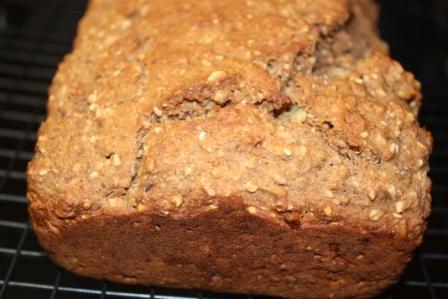
A definite winner. I’ll be making this one again and again. However, I would suggest soaking the grains a bit longer, perhaps 45 minutes, because there were still some rather hard bites to be found. I guess you could choose to sprout them as well, but I didn’t go that far. Also, any dark beer will do.
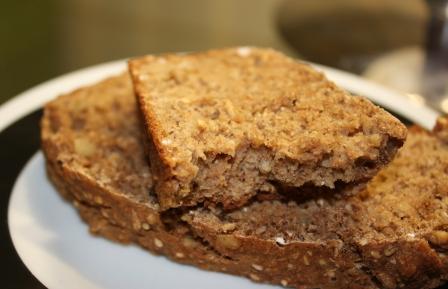
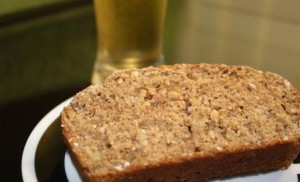
Fresh from the oven or toasted with jam the bread is full of crunchy texture with the mild sweetness of the dark beer. Hearty, healthy and filling – exactly what I was going for.
Nutty Grain Beer Bread

Adapted from Peanut Butter Boy’s Whole Grain Beer Bread
3 cups whole wheat flour
1 T mascavo sugar
1 T baking powder
1 t salt
2 T sesame seeds
¼ cup chopped walnuts
2 T ground flaxseed
1/3 cup steel cut oats (soaked and drained)
1/3 cup wheat berries (soaked and drained)
1 can (350 ml beer)
Preheat the oven to 375 degrees F and grease a 9 x 5 inch loaf pan. In a large bowl, gently mix together the flour, sugar, baking powder and salt. Stir in the sesame seeds and flaxseed. Next pour in the oats and wheat berries. It is fine if a bit of the soaking liquid goes in to add moisture. Mix well and then begin pouring in the beer a little at time as you stir until the can is empty. Then stir until the dough is well combined.
Pour into your baking pan, spread evenly and bake for 45 min to 1 hr. Once browned and baked through, remove from the oven and cool on a wire rack for about 10 minutes. De-pan and enjoy!


For me, this brings on visions of those meals and desserts that are my absolute favorites and which also use prepared, packaged ingredients. Things, at first thought, I would sorely miss and the elimination of which may even erase some fond memories. They’re okay in moderation, it doesn’t hurt to have it once a week/month/year, progress in food development isn’t all bad. Right? Well, these are the things I’m starting to question.
Tuesday morning started out just like any other day. I went into the kitchen first thing, grabbed a coffee filter, added some of a my favorite Brazilian grounds, poured the water and pushed the red button. The button illuminated so I walked away to straighten up the kitchen then start up the computer.
A few minutes later I thought, “Hmmm, I don’t hear anything. More importantly I don’t smell anything.” I have a very inexpensive model of coffee maker I bought here and usually within seconds of pushing the “on” button the water starts to gurgle and a little steam is emitted from the top.
Still positive I went over and felt the machine. Cold. I checked inside and out for some sign of proper function, and started it again. Nothing. My calm, positive attitude slowly evolved into a bit of frantic thinking, and rattling and shaking the machine ensued.
Alas, the machine won. Less than two years old and it has bit the dust.
What to do, what to do. One option included buying a new maker for my last two months in Brazil. A possibility, but it seemed a bit wasteful. I could try to sell it upon moving or just leave it. The quality of small kitchen appliances here isn’t something you would want to ship home, trust me.
Sadly, investing the money in purchasing coffee every morning isn’t even an option here. There was no to-go coffee within the city until the McDonald’s started serving breakfast and selling it last October. I’ve had it a couple times and it is tasty and inexpensive, but it seriously takes a half hour to get the order here with your only bonus being it comes in a to-go. (That has been quite a big bonus, though, on some occasions.)
Then I started thinking. Well…I do have one more option which would eliminate the need for me to buy a machine or support the golden arches.
Meet my morning coffee maker.

Several months after living here I learned about the so-called “artisanal” way of making coffee. There are several cafes around our city that still make it this way for the public. I enjoy going there and watching the women behind the counter serve it to the men there for a quick cup in the morning while standing. Once my interest was peaked I bought the supplies and made it a few times for myself.
It wasn’t until we met with some new friends in Curitiba, that I learned that this style of making coffee is considered old school and artisanal. Apparently it is a lost art in many larger cities in southern Brazil. For comparison Curitiba is a city of almost 2M and Maringá has about 300K. Not so small in the US, but small by Brazilian standards when you compare it to cities such as Sao Paulo with 18 to 19M the last time I checked.
The process is simple. You toss the coffee, which is ground very finely here, into a pot with water. I use about 2 scoops of coffee for 2 ½ cups of water. You throw in the sugar at this point too. For me, that is a rounded teaspoon. Then you boil. Not a hard long boil, but enough to get it hot and dissolve the sugar and some grounds.

Next comes the filter that looks like a mini-fishnet. Made of cloth, the coffee drains through it like a filter so your grains don’t go to the cup. You pour the coffee through the filter and allow it to drip directly into the cup.


The process isn’t much unlike a mechanical coffee maker except for the fact that the coffee is cooked directly in the water. The water isn’t simply flowing through the coffee and into a pot. Although you do have to be present throughout the whole process.
It is also similar to what we call cowboy coffee or campfire coffee back home. Well, except for the fact that I’m using delicious Brazilian coffee beans. I would imagine it is tastier than most made at campsites. The brewing process results in a much stronger brew. I enjoy it, but I always have it café com leite-style with milk.
The negatives are the clean up. I have to dump out all those grains, scrub the pot, clean the filter contraption well and allow it to dry after I make coffee each morning. I’m starting to get used to it though. I guess in this case I looked at going without the maker as a challenge. Why not enjoy the piece of culture I have for the time being? Even if it does mean an extra 10 minutes of cleanup in the morning.
This post dates back to 2009 when we were still living in southern Brazil. It is where I learned about eating avocado as a sweet fruit and not a savory ingredient. I was taught how to combine avocados and bananas to make fruit salads and shakes. It was long before the avocado-in-everything craze hit the U.S.
I think I’ve mentioned before that around here avocados are eaten as a fruit; sweet, not savory like in many other cultures. You won’t find it on sandwiches, in salads or as a salty condiment such as guacamole. Now I still love to enjoy my avocados the old fashioned way, as I refer to it. However, I’ve been really open to the idea of eating them sweet.
At my husband’s office a popular snack is to take fresh avocado slices, sprinkle sugar on them and eat them as I would apple or peach slices. Other Brazilians have told me they cut it open sprinkle sugar on it, drizzle it with lime juice, and eat it with a spoon. I’ve tried it with just the sugar and you know what? It isn’t half bad.
When I posted about this new-to-me food phenomenon on my ex-pat blog I got a lot of responses about avocados and bananas. Soon after that I went to my favorite little vegetarian buffet down the road and one dish on the salad bar was a bowl of cut up avocados and bananas together.
Nani, a Brazilian ex-pat living in Arizona, once commented on my blog that her dad was famous for his Vitamina de Banana e Abacate (banana and avocado vitamin). A smoothie of sorts made with avocado, banana, milk and sugar.
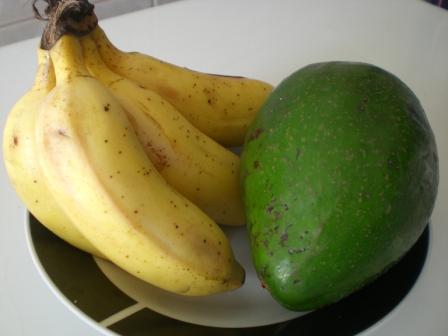
As interested as I was in this drink, it took me a long time to get around to trying it. In fact, I bought an avocado at the market last week and until last night it had been staring at me each time I opened the fridge door. Finally, last night after my run I gave it a try.
Oh my! I have no idea why I waited so long!
I have never had anything so creamy, sweet and slightly buttery. Words simply can’t do it justice. It is the ultimate of healthy, filling drinks. If you don’t like avocado, don’t worry. There is something that happens to the flavor once it is mixed with the banana. Honestly, I’m not sure I would identify it as avocado if I didn’t know it was in there. The best part is that it is full of potassium, monounsaturated fat, vitamin E, protein and calcium!
I froze my slices of banana first because I wanted the drink to be really cold and have a little texture. I also did not add any sugar. The banana was sweet enough. Finally, I used skim milk in my version.
One ripe avocado, peeled and pitted
1 ripe banana, sliced (frozen if desired)
Milk<
I used an immersion blender and a glass because that is all I have, but a blender would work well too. Blend the avocado and banana well. Slowly add a little milk at a time until you reach your desired consistency. I added about a cup. Pour it in a glass and your ready to enjoy!

One of the best things about traveling or taking part in an ex-pat experience is that you get to try the real thing when it comes to the foods of the place you are visiting. This can be as close by as Memphis barbecue or as far away as pasta in Italy. While foods are imitated everywhere and a select few are exactly like the real thing, many aren’t.
I have yet to have a German sausage that was anything like those that I’ve had in Germany and Austria. There is nothing to compare to the freshness of a pint of Guinness in Ireland. No jerk chicken tastes quite like that which can you get made the traditional way in Jamaica.
I’ve mentioned before that since being in Brazil everyone always asks about feijoada, the national dish made of black beans and pork and accompanied by rice. I think this dish serves as a great example of one of those foods made elsewhere, but is never quite captured completely. This is mostly because with foods such as this we tend to take out those parts that don’t fit well with our culture.
I’ve been in Brazil two years and until Saturday I had never had feijoada. There are two reasons for this. One is because I really didn’t have any doubts that I would like it; I mean its rice and beans with meat. It really isn’t incredibly different. The second is because this is how a conversation typically goes regarding feijoada with almost every person we’ve discussed it with in Brazil.
Them: “Have you had feijoada?”
Me: “Not yet.”
Them: “Oh you have to try it. It is soooooo good.”
Me: “I’m sure it is. I’m just not too interested in the random pig parts that show up in there.”
Them: “Oh, I wouldn’t have feijoada out. I only eat the feijoada my (grandmother, mother, etc.) makes.”
Basically people tell us to go eat it, but that they wouldn’t. That really didn’t provide much motivation for me. However, my husband did want to try the real thing and I felt compelled to try it since we are living here and I wanted to be able to say that, yes, I had eaten feijoada.
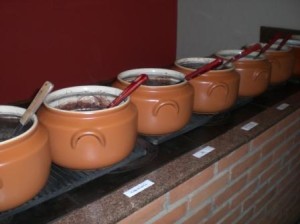
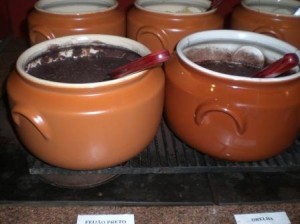
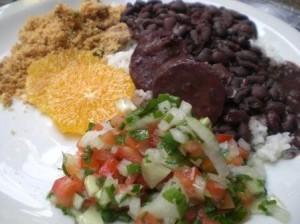
So we headed out Saturday to a local feijoada buffet. The good thing about these buffets is that they separate out all the parts. Each of these crocks is filled with a different version of feijoada with different meats, including one that was simply black beans.


I ate only the variety that had calabresa (a sausage) and a little bit of carne seca (dried meat). However, if one were so inclined you could have pé (pig’s foot), orelha (pig’s ear), or rabo (tail).


The truth is I may be willing to try a bite of these mystery meats, and I did some digging around with the spoon to see what they looked like. However, as I pulled up the spoon to see a big piece of flabby pig ear, I knew I couldn’t do it. A bite is one thing, but having a huge piece of it staring back at me from my plate is something I just can’t stomach.
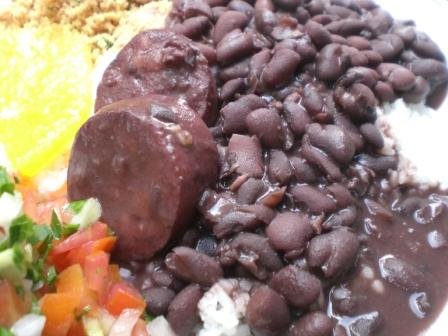
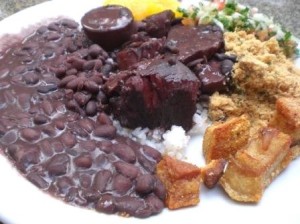
Below is a picture of my plate with calabresa and my husband’s with calabresa and carne seca. The best part of the meal for me is usually the addition of farofa (that toasted manioc flour) and the vegetable vinaigrette.
This meal is also served with orange slices to “help with digestion”. I’m not sure how technical this recommendation goes beyond that statement. However, I suspect it has something to do with the fact that vitamin C helps the absorption of non-heme iron like that found in dried beans.
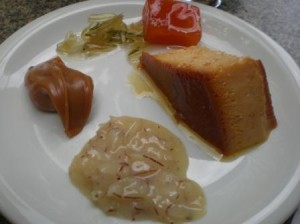
I must cover the desserts as well. You know me.

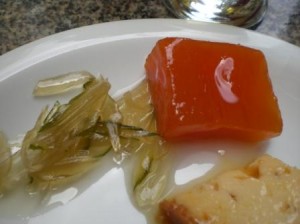
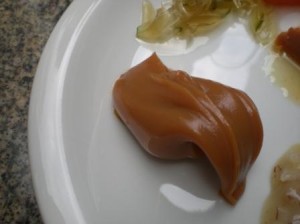
There was a small buffet of cocada (coconut in sweetened condensed milk) and pudim which is a flan. There were some candied fruits such as abobora (pumpkin) which is one of my favorites. It is candied in a ton of sugar along with some spices, namely clove. Finally at the end of the table was a huge bowl of doce de leite.


As we were eating our dessert, a thought occurred to me. Back home we tend to put those decadent things like caramel or doce de leite in the center of the cake or in the frosting all the while wishing we could dig into a big bowl of just that. Well, here they go straight to the punch and do just that! Doce de leite is eaten as a dessert all on its own.


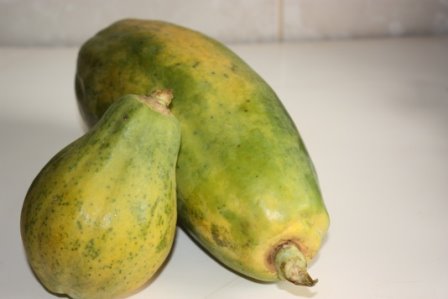
Most of us are pretty familiar with the papaya even if we don’t live in a place where they are regularly available. The papayas I had always been familiar with were about the size of a large white potato.
When I came to Brazil and started exploring all the fruits, I soon found papaya was widely available and very popular. It is the main component of salada de frutas (fruit salad) when you order it at a restaurant and I have yet to see a juice menu without it listed.
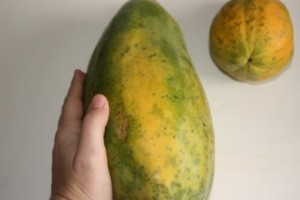
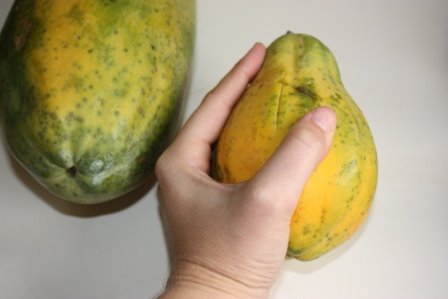
I found those small papayas I was familiar with right away in the supermarket. They are called papaya in Portuguese, too, but sometimes you will find it spelled papaia. Then I kept coming across this fruit that looked like an overgrown papaya and the signs always indicated it was mamão.
Here are pictures so you can see the size difference. The mamão is a huge fruit.


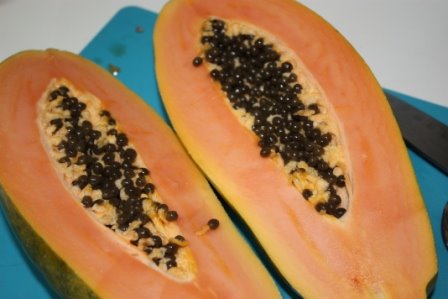
Upon purchasing one and trying it at home, I quickly realized it is really just a big papaya. I’ve asked around about the two fruits and that is pretty much what everyone here tells me as well. Although, the smaller papaya is supposed to be a bit sweeter. I can’t tell a flavor difference though. They look and taste exactly the same to me.

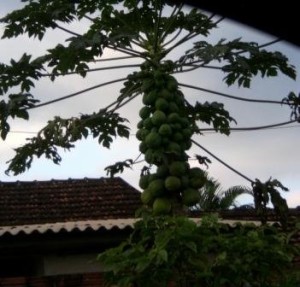
To tell you the truth, I’m not a huge fan of papaya. I enjoy it mixed in with other fruit in fruit salads and juices, but I don’t like the flavor enough to sit down to a big piece of it. Actually the most interesting thing about the fruit, the mamão specifically, is how it grows. I have been trying like crazy to get a photo because typically I only see them when we are driving. This is the best I have been able to do.

They grow on a tall, incredibly skinny tree that branches out with leaves at the top. The fruit grows in numerous bunches right at the top of the trunk.
Despite the fact that it isn’t my favorite, I do buy papaya or mamão every now and then. I consider it my duty to appreciate my access to all these good things and it usually goes into juice. However, the other day I was feeling a little creative.
I wanted to use the mamão, but wasn’t hungry for dessert. The thought of a bread entered my mind, and then, why not a breakfast cake. Who doesn’t want cake for breakfast?
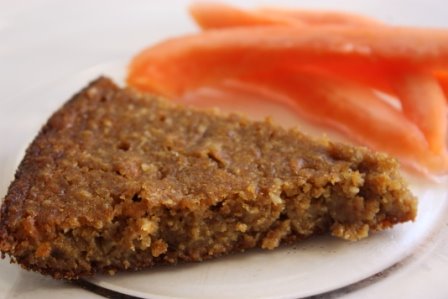
This cake is full of whole grains and is hearty and filling. The papaya simply adds moisture as the flavor of the fruit itself isn’t very strong. I will say that it is very, very buttery. In fact, I think I’ll probably reduce the butter to a 1/3 cup the next time I make it. Because it is so moist, you’ll want to store any leftovers in the fridge.

Papaya Breakfast Cake
Makes a 10 inch round cake
½ cup butter, softened
½ cup mascavo sugar (unrefined cane sugar)
2 eggs
1 cup papaya or mamão, pureed
¼ cup steel cut oats, soaked for at least a half hour and drained
½ cup whole wheat flour
1 tsp baking soda
½ tsp salt
Cream butter and sugar, then mix in eggs. Stir in papaya and mix well. Next stir in the soaked oats and stir until combined. Finally add in flour, baking soda and salt and stir to combine all ingredients.
I used a lightly greased 10 inch round, glass baking dish. However, given the amount of butter I think I could have gone without greasing it. Any square pan would work fine too. Bake at 375 degrees F for about 25 minutes, until edges are browned and center is baked through. Allow to cool about 5 minutes, serve warm or at room temperature.
Thanks for reading! All images and content are the property of Fake Food Free and Lori Rice unless otherwise stated. Please do not republish full recipes and images without written permission. What is okay? Feel free to Pin images, share links to my posts or share the photo in a round up post with the title of this recipe and a link back to the post. Confused about copyright and food blogs? Here is some helpful information on Recipe Attribution. If you want to use a photo or full recipe, just ask. I’m sure we can work something out.

When I left it looked like this. These little things are pretty amazing.

It took me forever to find fresh basil in Brazil, mostly because I had no idea what the name was. It is called manjericão in Portuguese, by the way. Its availability isn’t consistent, but when I find it I always grab some. I love the smell. Basil is tied with rosemary for me regarding my favorite herb scent.
Of course, I am also interested in the nutritional value of basil and herbs in general. It turns out that oils in basil have anti-bacterial properties and it is packed with vitamin K (3). In addition to its role in blood clotting, more recent research has linked vitamin K to bone health indicating that it plays a role in the development of bone mineral density and in decreased risk for bone fracture(1).
In addition, more research has confirmed that if you want these bone health benefits, skip the supplements (2). The benefit is seen when consuming more vegetables and legumes, not vitamin K1 supplements. Of course this makes me very happy. I think we all know I am in favor of food not pills.
There are two main things I use my basil for – one is margarita pizza and the other is pesto. My first experience with pesto involved dried basil and garlic, which is good, but not at all the same as using the fresh herbs.
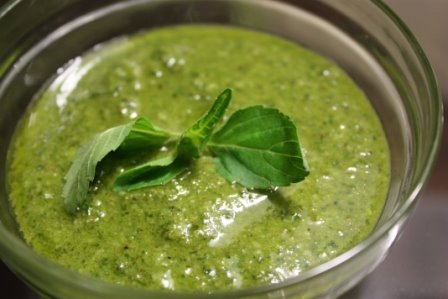
This is one of my favorite types of pesto using basil and walnuts. It is a modified version of the type we used to make in the bread store I once worked in. The ingredient amounts are very general, just tossing in this or that until you get the preferred consistency. I use it for pasta, pizza sauce, in scrambled eggs and of course spread across a warm slice of bread.
1 bunch fresh basil, about 1 cup loosely packed leaves
2 cloves fresh garlic
2 handfuls chopped walnuts, about 1/3 cup
2 tablespoons parmesan cheese, freshly grated
Salt and pepper to taste
Olive oil
In a food processor (or in a tall mixing glass if you plan to use an immersion blender like I did) combine the basil and garlic and process about 15-30 seconds until things are roughly chopped. Add the walnuts, cheese and about a tablespoon of olive oil.
Process as you add in a little olive oil at a time. Continue until all ingredients are combined and nuts are ground. Continue to add olive oil until you reach your desired consistency. I like mine a little thick so it is spreadable, but if you want to use it as a dressing, add more. Taste and sprinkle with salt and pepper as desired. Makes about 1 to 1 ½ cups of pesto.
References and more on the health benefits of basil:
1. Pearson, Debra A., Bone Health and Osteoporosis: The Role of Vitamin K and Potential Antagonism by Anticoagulants. Nutrition in Clinical Practice. 2007; 22(5): 517-544.
2. Shea, M., Booth, S.L. An Update On The Role Of Vitamin K In Skeletal Health. Nutrition Reviews. 2008; 66:549-557.
3. World’s Healthiest Foods: Basil