

I regularly revisit the goal to challenge myself in the kitchen by experimenting with cuisines from different areas of the world. I don’t always accomplish this goal, but over the past several months I’ve been happy with the variety around here. Foods from South Africa, West Africa, Ireland, Thailand, the Caribbean, and Italy have all found their way into posts.
I owe a lot of this to cookbooks. My most recent endeavor? A closer look at Filipino cuisine.
Other than the Filipino barbecue recipe learned from my husband’s college friend, I have no experience with the cuisine. I’ve not stepped foot in a Filipino restaurant (only because I’ve yet to have the opportunity), and while we entertained the idea of making Manila a stop on our Southeast Asia trip in 2009, it wasn’t meant to be on that adventure.
So needless to say, I had a lot to learn. After reading this cookbook, I have been thoroughly educated.
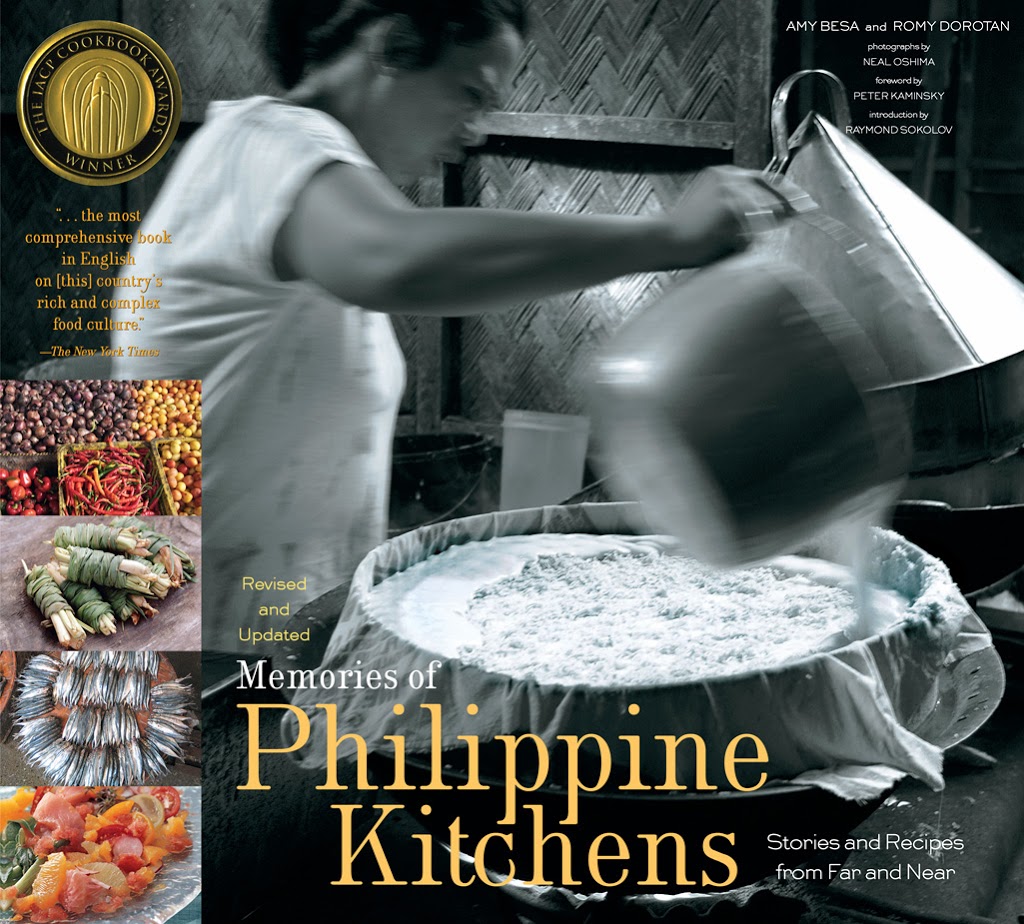
Memories of Philippine Kitchens: Stories and Recipes from Far and Near by Amy Besa and Romy Dorotan is a history book of traditional dishes. I received a revised and updated copy for review just a few weeks ago. The beautiful photos take you there – to the market stalls, to the rustic kitchens – you can almost feel the ingredients your hands and smell them cooking. The recipes make you wonder how you can bring such time-honored practices into your own kitchen; a challenge I welcome.
While taking a journey through geographic regions of the Philippines by way of food, the book introduces the reader to unfamiliar regions, and foods that seem different, but familiar at the same time. Dishes such as the classic Chicken Adobo, sweet Bibingka, and Lumpia. These names only mention the type of food or style of cooking. The recipes and variations seem endless.
I stopped turning the pages at the province of Pampanga – The Rice Heartland of Luzon. This led me to the Arayat Kitchen where I found Bringhe. The book describes this dish as Filipino paella. I took a quick look at the ingredients, and set out to find some banana leaves which I finally located last week.
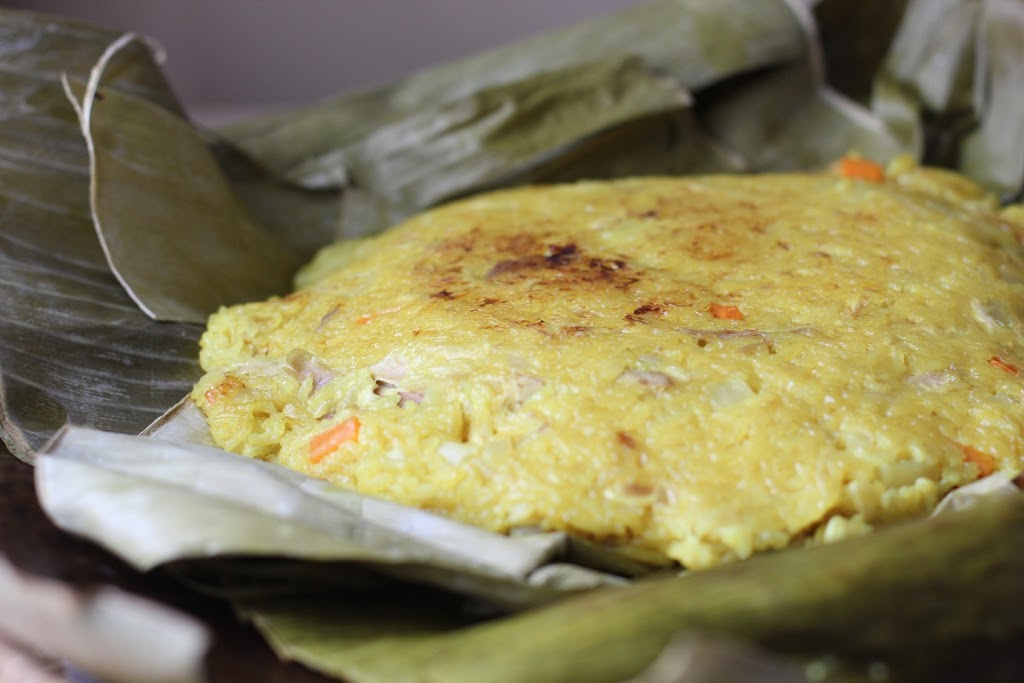
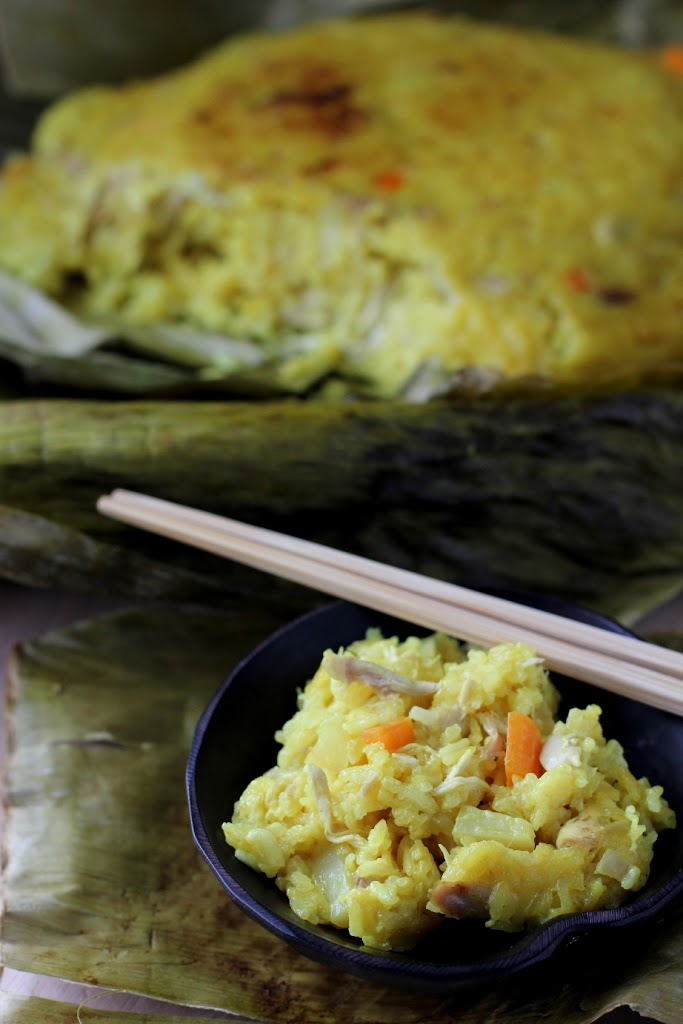
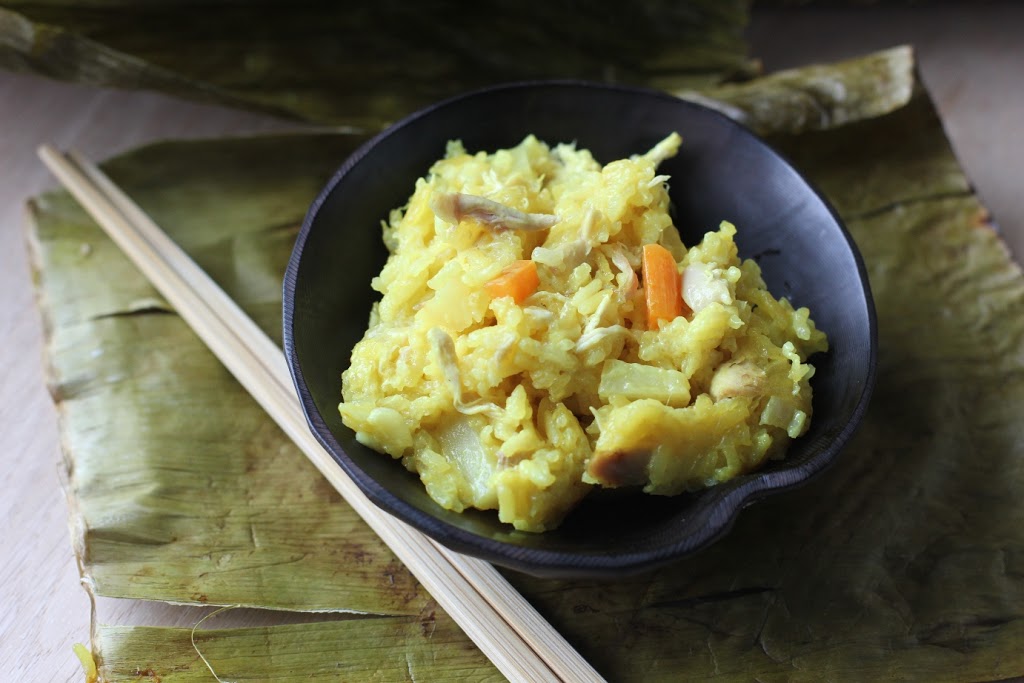
I feared steaming a dish in leaves in a wok on my very U.S. American stove would be a difficult task, but this recipe was a breeze. The results were a dinner of nutty sticky rice in coconut milk complete with vegetables and pastured chicken.
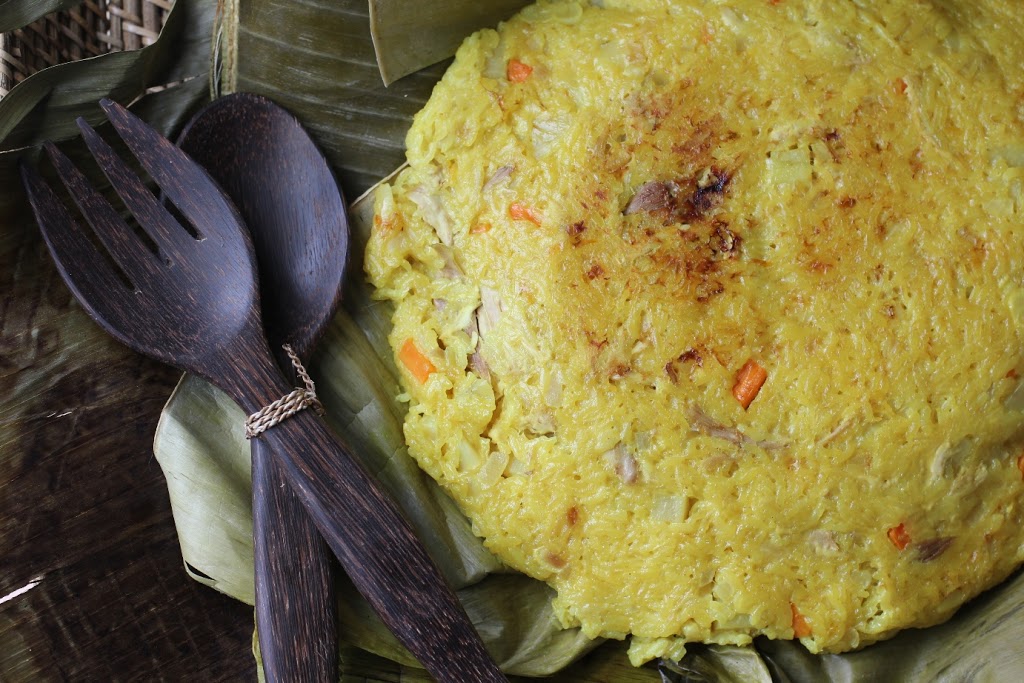
A one-pot meal at its finest.
There are very few times you find a book with so much of a culture within its pages. This book has a prominent place on my food history and culture bookshelf.
I’m off in search of my next food culture challenge, and considering how many more recipes I want to try in this book, I have a feeling it will be Filipino once again.
Bringhe
Reprinted with permission from Abrams Books
Bringhe is a Filipino version of paella, made with glutinous rice and steamed in banana leaves.
Serves 4 to 6
One 3 1/2-pound chicken
1 large onion, quartered
Banana leaf sections, for lining the wok
2 tablespoons canola oil
3 garlic cloves, sliced
1 medium onion, diced
1 red bell pepper, diced
1 large carrot, diced
1 large russet potato, peeled and diced
One 1-inch piece fresh turmeric, peeled and grated
(or 1 teaspoon ground turmeric)
2 cups glutinous rice, soaked overnight in water
to cover, drained well
About 2 cups coconut milk
4 tablespoons fish sauce, or to taste
Place the chicken and quartered onion in a large saucepan and add water to cover. Bring to a boil over high heat, then reduce the heat and simmer, uncovered, until the chicken is tender, about 40 minutes. Remove the chicken, strain, and reserve the broth. Set the chicken aside to cool, then remove the meat from the bones and shred it. Set aside.
Wipe the banana leaves with damp paper towels to clean them. Run them through a flame on both sides to soften them a bit. Grease a large wok (or 2 small woks) and line it with a double layer of banana leaves.
In a large sauté pan over medium heat, warm the oil. Add the garlic, diced onion, and bell pepper and sauté until the onion is translucent, about 5 minutes. Add the carrots and potatoes and cook until softened, about 5 minutes. Add the turmeric and stir for 1 minute, until aromatic.
Add the rice and cook, stirring, until thoroughly coated with the oil, about 5 minutes. Add 1 1/2 cups of the coconut milk, 1 1/2 cups of the reserved chicken stock, and the fish sauce. Bring to a simmer and cook, stirring frequently, until all the liquid is absorbed.
Add another 1/2 cup coconut milk and 1/2 cup stock and continue to stir until the liquid is absorbed. This should take about 20 minutes—the rice should be tender but al dente. If the rice isn’t cooked through, add more coconut milk and stock. Continue to cook, stirring, until the liquid is absorbed and the rice is cooked through. Add the shredded chicken and cook until warmed through, about 3 minutes.
Fill the prepared wok (or woks) with the rice mixture, smooth the top to create an even layer, cover with the lid or foil, and place over medium heat. Cook without stirring for 20 minutes, or until a golden brown crust that holds the dish together is formed at the bottom of the dish. If the crust hasn’t formed, raise the heat to medium-high and cook for another 5 to 10 minutes to form the crust. Invert onto a large serving plate, remove the banana leaves, and serve.
Disclosure: A copy of this cookbook was sent to me for review purposes. I was not required to write about it, and received no compensation for doing so. Opinions expressed here are my own.


Wow! You found banana leaves!! Did you by any chance discover a place locally that splits/grinds fresh mature coconut and squeezes it for fresh coconut milk (really cream)? I’ve been longing for that. I lived in Camarines Sur province for two years as a Peace Corps Volunteer. I am in love with JunBlog, blog.junbelen.com
Lovely post, Lori.
I love that you are such an adventurous cook! Where did you get the banana leaves?
This is absolutely marvelous! Bringhe is one of my favorite Filipino dishes of all-time because I am a sucker for sticky rice. 😎
I’ve had the pleasure of meeting Amy Besa here in Manila, as well as recently interviewing her (albeit via email) for an article. She is such a champion of Filipino cuisine and MPK is THE book not only to introduce neophytes to the food, but also to show how truly unique it is in its cultural and historical contexts.
I look forward to reading the revised edition and thank you for sharing this! 😎
Rona – Ha, ha! I wish! I would definitely share it if I did. I love JunBlog’s photography. Beautiful! I managed to find plantain leaves at Selby’s International Market. I did buy banana leaves at one time at Jungle Jim’s. Not having a trip planned, it was a bit of an adventure!
Jenn – Thanks! It’s a lot of fun! I found plantain leaves at Shelby’s International Market on Harrodsburg/Broadway. I love that store. They had frozen leaves which worked out well. They thawed just fine. I have found banana leaves at Jungle Jim’s in Cincinnati before, but felt fortunate to find something similar locally.
Tangled Noodle – Thank you! That means so much. I love sticky rice as well, and I’m pretty sure that was the main ingredient that attracted me to this dish. I also have some huge bags to use up so it worked out well. Any chance that article is accessible to someone here in the States? 🙂 I’d love to read it. I’m looking forward to reading the book in more detail throughout the summer!
I’ve never really delved into Philippine cooking either, mostly from lack of exposure! I need to try this dish though…glutinous rice and I are BFF.
Oh I thought it was an omelette from the photo! Where
Its a cuisine I’m not super familiar with either but if that dish is a typical i think i’d love it.
Hi Lori! Your awesome review & Bringhe dish was shared with me by the author herself, Amy Besa. What a great rendition! Thanks for liking our very own Filipino food. There’s more where that came from. Meanwhile, enjoy the “Memories of Philippine Kitchens”…it’s one of our best Filipino cookbooks!
You are very brave in trying a unique dish such as this. I love cooking with sticky rice. This looks really flavorful.
i heard about bringhe, but this is the first time i saw a photo of this dish….mukha pala itong masarap!
It is interesting that I have not had Filipino food besides the eggrolls and noddles…bringle sounds very intriguing…and I know I’ll like it since I love everything that has glutinous rice…and one pot meal are the best 🙂
Thanks for sharing this recipe and hope you are having a fantastic week Lori 🙂
Thanks for sharing this beautiful dish, i know i will love this because i like everything cook with glutinous rice.
I’m looking forward to learning from this book! And, this dish looks fantastic. I’d love to try steaming in banana leaves.
I’ve never tried Filipino food. This looks delicious! I keep meaning to stop by Selby’s and may have to make that a to-do item today!
Joanne – I’m the same way, and I hope sticky rice can have two BFF!
Michelle – Ha! It kind of looks like it!
kat – I feel the same way. Looking forward to exploring more.
Elizabeth – Wow, thanks so much! I’m glad we were able to connect on Twitter!
myFudo – Thanks! I love experimenting!
reyah – The picture in the book is a bit more browned and deeper like it was made in a smaller wok, but I was happy with the results.
Juliana – I love one pot meals and stick rice! 🙂
Sonia – So many fans of glutinous rice. It really is great!
lisa – Thanks! It’s a great book. So much easier than it sounds! 🙂
Candy – I really like that store. It’s small, but they are always so friendly and willing to order anything for you.
I need to find some banana leaves so I can make this! I guess a trip to Jungle Jim’s is in order…
Ahhh, this looks so good! And nice blog makeover 😀
That looks really good. I just bought the book and I wasn’t sure what recipe to start off with first. Coincidentally, I have banana leaves in the freezer so im going to have to try this today. Hopefully my attempt turns out as good as yours. I admit I was thrown off my the chopsticks as they dont use them in the Philippines. But then again,they dont use them in Italy but that never stopped Julia Child from suggesting that you eat spaghetti with them. 🙂